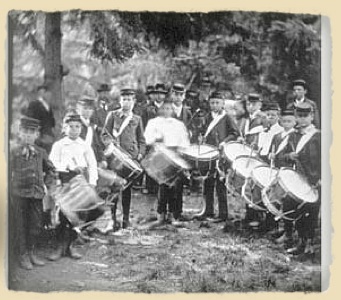
 above: A candid photo from the Smithsonian archives taken in 1860 shows just how young the Drummer Boys of the Civil War were.

One morning George and his Eighth Maine regiment received orders to march to City Point to pick up recruits. George picked up his drum and marched at the front of the line. Suddenly the order to double quick march was yelled out. They were under attack and as bullets whizzed by their heads and shells exploded around them Charley screamed at George to get to the rear. Instead, in all the smoke and confusion he stayed close to his brothers in arms until fear and self-preservation took over. He found himself running until he couldn’t run anymore. Taking inventory he was surprised to see himself completely whole but his poor drum riddled with bullet holes. George’s unbelievable run of luck had held.
As George sat there listening to the battle around him, he was joined by another young Drummer Boy from a Pennsylvania regiment. Feeling braver with two,they bragged about their exploits and adventures. George was impressed with his new friend’s amazingly profane mouth. Showing off, his new friend picked up a tent stake and tried to stake it to show what he would do to their enemies if he ever got a hold of them. Unable to get the stake to hold he picked up an unexploded shell saying:
“I’ll make a mawl of it and drive that damned rebel stake into the ground with one of their own damned shells, be damned if I don’t.” Inserting the broom handle into the end of the shell he walked over to a stump, and taking the shell in both hands commenced pounding onto the stick against the stump; “damned tight fit,” he hollored to me.
George story soon took a shocking turn as he writes in his memoirs:
The next instant I was knocked down by a terrific explosion. I came to my senses in a minute and hastened to where he had been standing. There the poor fellow lay unconscious and completely covered with blood, there was hardly a shred of clothes on him, his hair was all burned and both hands taken completely off, as if done by a surgeon’s saw.
I was excited and horror stricken for a moment. The sight was horrible, but I quickly regained my composure, knowing that something must be done, and done quickly. So taking the snares from my drum I wound them tightly around his wrists to stop the flow of blood, then I hailed an ambulance, and we took him to the held hospital about a mile to the rear.
On the way the poor fellow regained consciousness, and looking at his mutilated wrists, and then with a quick and bewildered glance at me, “God damned tough, ain’t it,” then the tears started in his eyes, and he broke down and sobbed the rest of the way, “Oh, my God! What will my poor mother say? Oh, what will she do!”
We reached the field hospital, which is only a temporary place for the wounded where the wounds are hurriedly dressed, and then they are sent to regular hospitals, located in Baltimore, Philadelphia, Norfolk, Portsmouth, etc., where they have all the comforts possible.
We laid the little fellow down in one corner of the tent to wait his turn with the surgeon, and when I left him, he cried and begged for me to stay, but I couldn’t stand his suffering longer, so I bade him good-bye with tears streaming down my own cheeks. I hurried out, and even after I reached the outside I could hear him cry, “Oh, my God! What will my poor mother say? Oh, what will she do!”
Did George write home about this sad day? Did he question his own mortality seeing the death of someone so near his own age? No letters home have been found but as an educated boy from an educated family I am sure that George spend many hours writing about his days at War. Most likely his stories home leaned towards the humorous so as not to upset his loving family back in Maine.
 me and lizzie may