When George’s regiment was ordered to march, he decided not to go. The last few weeks had shattered his boyhood illusions of war. He’d had enough. He no longer wanted to be a big hero, he just wanted to go home. Sadly his decision meant that he would part with his brother Charley for the first time. The close brothers shared a tearful good-bye promising to see each other soon.
George sat on a fence watching his regiment disappear into the horizon. He sat there a while longer than he should have lost in his thoughts. Out of nowhere, shells started raining down on him. The enemy had spotted him. He leaped off the fence ready to bolt like a rabbit when BAM! a splintered section of fence slammed into him knocking him to the ground unconscious.
The next thing he knew, he was laying in a hospital bed fuzzy headed and unable to move. He had no recollection of how he got there. The field hospital did not have the capability to care for him so he was transferred to the main hospital which was set up in the Balfour hotel in Portsmouth,VA. Unable to walk, he was carried into the old dining room which now served as a dormitory for wounded soldiers. There were over 200 iron beds in that room. He was laid down on one of the beds and exhausted soon fell asleep waiting for the doctor.
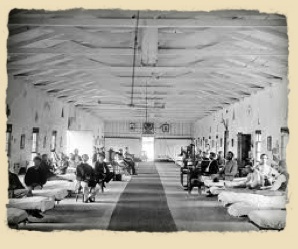 Hospitals in the 1860’s were nothing like the hospitals of today. In 1863 the government did an inspection of military hospitals that treated Union soldiers. Of the 892 Union hospitals reviewed, 589 received a good inspection but 303 were rated bad to unfit. Of the doctors who were inspected, 2,727 were up to speed on “modern” practices and ranked o.k. to good but 303 were ranked bad or unacceptable. As bad as the surgeon’s tents on the fields were, the hospitals of the day were not much better. Many soldiers died from either their battle wounds or disease in the hospital. It was so bad that soldiers considered a trip to the hospital a death sentence. The Union Army lists 67,000 soldiers killed in action plus 43,000 died of battle wounds and a terrifying 248,000 died from mostly from disease. Without antibiotics to curb the spread of bronchitis, infected wounds etc… death was imminent in so many cases. These numbers only reflect the Union which actually had better medical care than the South. The following information from CivilWar.com gives a sobering view about the wounds incurred from Civil War musketry:
When a minie ball struck a bone it almost never failed to fracture and shatter the contiguous bony structure, and it was rarely that only a round perforation, the size of the bullet, resulted. When a joint was the part the bullet struck, the results were especially serious in Civil War days. Of course, the same was true of wounds of the abdomen and head, though to a much greater degree. Indeed, recovery from wounds of the abdomen and brain almost never occurred. One of the prime objects of the Civil War surgeon was to remove the missile, and, in doing this, he practically never failed to infect the part with his dirty hands and instrument.

George awoke to the disheartening sounds of men in pain. Some of these brave soldiers moaned and sobbed softly. Others screamed delirious with pain and worst of all were those who lay silent wrapped in linens dripping with cool water. These were the burn victims and it was a terrible sight to see. He was still fuzzy headed and could not move his legs. The mischievous, friendly young drummer boy we have come to know and root for now lay silent in a hospital bed far from his brother who had protected him, far from his family who loved him.
 me and lizzie may