The Stage

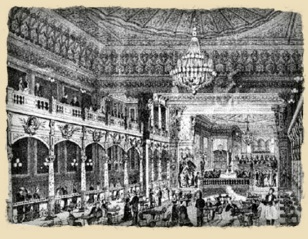
Koster & Bial’s Music Hall on 23rd street in Manhattan, the premier variety house of the late 19th century.

The second half of the 19th Century was an exciting time for the theatre. After the Civil War there was a huge influx of immigration and an enormous growth was seen in America’s cities, in particular cities on the East Coast such as Boston and New York. With the onstart of the Industrial Revolution, the growth of factories and increased productions, the continued hysteria around the Gold Rush, everything pointed to prosperity and growth for a class of people that became known as the Middle Class. Americans now had a better standard of living than ever before and with that, discretionary income to spend on entertainment.

Thanks to the expansion of the transportation system in the U.S., in particular the railroads which linked East Coast to West , actors were able to travel across America finally reaching towns that had never experienced any form of theatre before. Thousands of theaters popped up across the U.S. between 1850-1900. The growth of theatre brought an entire new cache of jobs from costumers to dramatic agencies to boarding houses and hotels who catered specifically to the trade.

Once no more than bare bones music halls soon morphed into beautiful, intricately designed theaters. The lavish productions against the backdrop of these elegant theaters became the ultimate from of entertainment.

Theater design and technology changed as well around the mid-19th century. Candlelit stages were replaced with gaslight and limelight. Limelight consisted of a block of lime heated to incandescence by means of an oxyhydrogen flame torch. The light could then be focused with mirrors and produced a quite powerful light. Theater interiors began improving in the 1850s, with ornate decoration and stall seating replacing the pit. In 1869, Laura Keen opened the remodeled Chestnut Street Theater in Philadelphia, and newspaper accounts describe the comfortable seats, convenient boxes, lovely decorations and hangings, excellent visibility, good ventilation, and baskets of flowers and hanging plants.

Theater crowds in the first half of the 19th century had gained a reputation as unruly, loud and uncouth. The improvements made to theaters in the last half of the 19th century encouraged middle and upper class patrons to attend plays, and crowds became quieter, more genteel, and less prone to cause disruptions of the performance.

The lure of the theatre was too much for George. He spent all of his free time visiting the multitude of music halls and theaters throughout Boston. At the Selwyn Theatre on Washington Street George was able to charm his way into bit parts in small productions. It felt like home and this new home was heaven.

Next Up:  A Surprise

Washington Street

Above: Actor John H Selwyn who would open The Selwyn Theatre in 1867.

In 1868 Charley Ulmer was running a small job printing plant on Washington Street in Boston. Younger brother George was Charley’s apprentice but he became increasingly distracted by a new theatre that had opened just down the street. Washington Street in the mid to late 19th century was the center of commerce and cultural events for Boston’s south end. In other words, it was the place to be!

In late 1867, John H. Selwyn a scenic artist with the famed Boston Theatre Company struck out on his own and opened up The Selwyn Theatre at 364 Washington Street. The Selwyn Theatre was a stock company that existed for only three years from the end of 1867-1870. At the time, it was renowned for bringing the most distinguished actors and productions of the day to Boston. George was hooked.

The history of Boston’s theaters often provides the researcher and theater aficionado with some fascinating drama of its own. In the nineteenth century, when Boston was the center of a thriving community of theaters, an ongoing conflict between artistic freedom and the city’s ubiquitous Puritan strain was clearly in evidence. Even as early as the eighteenth century, theater going in Boston was regarded as a fashionable, but not entirely legal pursuit.

A quaint example of Boston’s secret love-affair with the theater is witnessed in the names of early playhouses such as Exhibition Hall and the beloved Boston Museum, which really were theaters in very thin disguise. Indeed, the term “banned in Boston” was one used either pejoratively by theater lovers.

George had been bitten by the acting bug while convalescing in Balfour Hospital during the Civil War. He was entranced by the theatre. Soon he had cajoled his way into bit parts. The actors, the costumes, the audience clapping…it all appealed to our ham-ish hero.

Next Up: The Stage

What’s next for George?

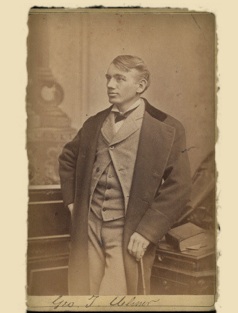
Above: a great photo of George from the George Stewart Collection

George basked in the glory of a hero’s welcome home. His family showered him with attention, patiently listening to his stories over and over again. He writes in his memoirs about his young step-sister Lizzie following him everywhere. She never tired of his enthusiastic ramblings and became a sounding board for his dreams of a big future.

For George, the War had opened his eyes to new places, new people and new experiences. He longed to get out and make a name for himself. A U.S. Tax assessment record from February of 1866 shows 16 year old George running his own “gift enterprise company” by the name of George T. Ulmer & Co. The tax assessment was $833.00. What he was doing is anyone’s guess. His charm and easy gift for gab probably made him an excellent salesman! No moss was growing on George’s stone.

In 1868 Charley married Laura and opened a small job printing plant on Washington Street in Boston. George  joined his big brother as an assistant, enjoying the sights and sounds of a bustling city. The Ulmer brothers were big dreamers and soon Charley was ready for a new venture. He  looked West for an exciting new future in an ever expanding America. After leaving Boston he published newspapers in both Denver and Pueblo, Colorado. By 1870 the driven and already successful Charley had moved his wife Laura, 2 year old son Philip and 5 month old baby boy to Chicago. It is here that I found the next official record of George.

George T Ulmer now 21 is listed on the 1870 Census as living in Chicago Ward 5 with Charley and Laura. George’s occupation is listed as “Printer” and the value of his estate is listed as $3,000.

Five years after the Civil War ended the inseparable Ulmer brothers were still together.

Next Up: Washington Street