On stage thrills lead to on stage spills…

Lizzie and George were now more than half-way through a successful theatre season in Halifax. On March 22,1877 the company performed the thrilling Military drama Rosedale

Rosedale was first produced at Wallack’s Theatre in New York on September 30th,1863. Rosedale was typical of the sensation plays of the  day. Melodrama and more melodrama were then topped off with a “thrill” sequence to make the audience jump out of their seats. The audience got more than it bargained for this evening. The big thrill sequence in Rosedale was called the gypsy drill  in which a large number of soldiers were to suddenly appear on a bridge at the back of the stage and aim their guns at the marauding gypsies who are about to attack. To add  a sense of realism to the scene, a company of the 66th Halifax Battalion of Infantry volunteered to play the role of the soldiers for this performance.

Perhaps they got carried away? One of the Infantry volunteers by the name of John R. Roome, jumped too far and missed the bridge entirely instead falling 20 feet to the floor beneath the stage. Ouch! Dr. Trenaman, the local doctor was called to the theatre to attend to the injured Infantryman. Mr. Roome suffered cuts, bruises and what the Acadian Recorder called “injuries of a more serious nature”. Broken bone? Cracked rib? According to the newspaper, Mr. Nannary sent $50 to the family of the injured man and regards from the Company for  a quick recovery.

Never a dull moment!
May the best man win…best looking that is!

george t

                                                                                      HW HARKIN

                      George Ulmer    vs.     W.S. Harkins

Today’s soap operas have nothing on 19th century melodrama.  On March 14,1877 Lizzie May’s troupe performed a play titled Ben McCulloch or Sartin as Death.  It’s a strange title and after a week of research I have found no information about the play except a review from the Acadian Recorder newspaper from March 14,1907.

Ben McCulloch (1811-1862) was an actual person who lived a very colorful life. He was a  Texas Ranger, a Sheriff, a good friend to           Davy Crockett, a Prospector during the 1849 Gold Rush and finally a Confederate General killed during a Civil War battle in 1862. The play which I believe is based on his life certainly had enough drama to draw from!

According to The Acadian Recorder dated March 14, 1907, 30 years ago the play at The Academy was Ben McCulloch or Sartin as Death. The main character was played by Oliver Dowd Byron making his first appearance in Halifax.

The reviewer writes ” Ben McCulloch is practically one of Buffalo Bill‘s blood and thunder stories dramatized, and from the beginning to end there is no cessation of interest. the lynching mob, the burning swelling, the daring rescue, the villainous plot, the robbery, the state prison, the mad Ben, the churchyard in the storm with it’s premature graves, the attempted murder, the exciting recontre, the touching meeting after long years of wasting sorrow, were the composites of the play.

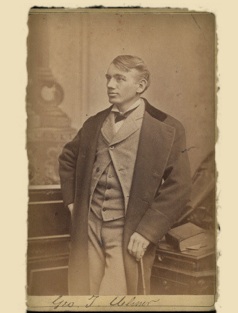
George who fancied himself to be a looker must have been annoyed by the rest of the review regarding a young actor named W.S. Harkins.

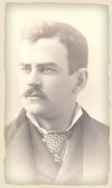
W.S. Harkins is alleged to be the best looking member of the Nannary Company. it has been said that several impressionable young women in the city have fallen in love with him, and that the Academy of Music audiences have been augmented in consequence“.

Sorry George, that’s got to hurt the ego! Lizzie May does not receive a specific mention but as this is a root ’em toot ’em masculine play her role was most likely a small one as damsel in distress or saloon girl.

You decide. Check out the photos of George and W.S. . Who do you think would make the girls swoon?

Caste

Caste

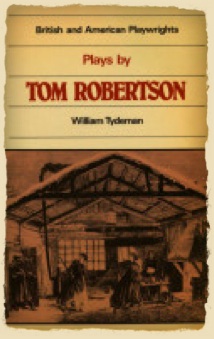
On January 25th,1877 , the Academy of Music presented the play “Caste” written by Thomas William Robertson. Caste is Robertson’s best known work. The primary theme within his works played off the differences between class levels within society. His writing was fluid and known to have a more natural feel than that of his contemporaries. Robertson felt that British drama needed plays to reflect the times without introducing artificial plots and forced passions.

Caste written in 1867 dealt with a poor dancer named Esther who falls madly in love with George D’Alroy the son of a Marquis. Of course many misunderstandings and heartaches ensue.  At one point Esther is devastated by the false reports of D’Alroy’s death in India. Esther although born of the lower classes somehow has the temperament and bearing of the upper class. She is eventually accepted as D’Alroy’s husband by society. Esther’s sister Polly is written as a high-spirited, crass type which ensures lot’s of comedic situations.

Lizzie May played the perfect supporting role as the vulgar Polly Eccles. Reviews were strong. She was said to have taken the honors for her role. Praised for her diversity and her operatic singing she received several rounds of applause.

Lizzie May’s husband George also received accolades for his role as Sam Gerridge. He was said to portray Sam with  good humor and had a great rapport with the audience.

Our little soubrette and the drummer boy were well on their way!

Under The Gaslight

undergaslight

Thanks again to The University of New Brunswick I continue to enjoy peeking into the past to follow Lizzie May’s first big season as an actress.  As a soubrette in William Nannary’s troupe, Lizzie May was part of the extremely popular production of  Aristophanes’ The Clouds . 

The dramatic season at the Academy of Music lasted 11 weeks. The popular Clouds was followed by New Men and Old Acres, My Mother-In-Law and many others.

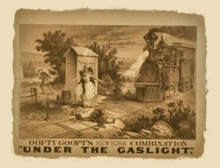
Audiences were soon entranced by the company’s production of Under The GaslightUnder the Gaslight written in 1867, is such a fantastic example of the melodramatic plays of the day.  The story reads like a soap opera… Laura Cortlandt  is jilted by her lover, Capt. Ray Trafford  when he discovers she is merely an adopted daughter (the scandal!) and actually of mere humble parentage. Laura in shame runs away from home but is dragged into court, where the villainous Byke  claims that she is actually his child and so is given custody of her. He attempts to take poor Laura to New Jersey but is stopped by a one‐armed ex‐soldier named Snorkey (you can’t make this stuff up!), and the dashing Captain Trafford. In the ensuing tussle, Byke throws Laura into the river, but she somehow swims to safety and returns to the family who adopted her. It gets even better. The furious Byke then decides to rob the Cortlandt home. Snorkey overhears his plans, but then the evil Byke catches him and ties him to the railroad tracks (!) knowing that an express train will soon pass by and crush him! Laura out for a walk just happens to see Snorkey tied there and releases him moments before the train comes. She then returns home to live happily after ever with the handsome Captain Trafford.

Apparently the famous railroad scene that thrilled audiences was said to have been borrowed by an English play written a few years before called The Engineer. Later, the hero or heroine tied to the train tracks became a staple of early cinema.

Daly’s play is famous for introducing the cliched “thrill” device…offering one sublime, extremely realistic wow moment such as a fire rescue, a volcano erupting, a shipwreck etc… These so-called “sensation plays” were used by many theatre companies to draw in the crowds.

Whether Lizzie May played the lead is not clear but I think she would have made a wonderful Laura.