Talented and Promising Artist

” Lizzie May Ulmer certainly is one of the most talented and promising artists on the American Stage”

– Boston Express

The New York Dramatic Mirror founded in 1879 was the Bible of the late nineteenth century theater world.

Charismatic editor Harrison Grey Fiske balanced the important professional information relied on by theater professionals with juicy gossipy items for theater buffs as well. Fiske  used the paper to crusade for actors rights and was instrumental in establishing the Actors’ Fund .

Wikipedia describes The Actor’s Fund as a nonprofit umbrella charitable organization that assists American entertainment and performing arts professionals through a broad spectrum of programs, including comprehensive social services, health services, supportive and affordable housing, employment and training services, and skilled nursing and assisted living care.
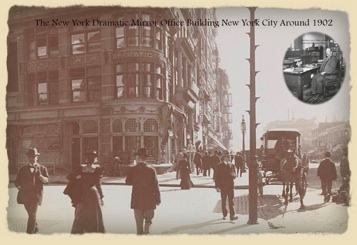
The Mirror (later its competitor Variety) was a place where actors could post their addresses, current situations, etc.. It was also a  place for them to find their reviews and reviews of  their contemporary’s latest performances. For the 1879-1880 season Lizzie May’s name appears regularly in The Mirror with many good reviews of her play “My Partner” in which she plays the leading female role of Clip:

Lizzie May Ulmer has been playing the leading female part in My Partner on the road to the satisfaction of the press, public and management.


Washington Street

Above: Actor John H Selwyn who would open The Selwyn Theatre in 1867.

In 1868 Charley Ulmer was running a small job printing plant on Washington Street in Boston. Younger brother George was Charley’s apprentice but he became increasingly distracted by a new theatre that had opened just down the street. Washington Street in the mid to late 19th century was the center of commerce and cultural events for Boston’s south end. In other words, it was the place to be!

In late 1867, John H. Selwyn a scenic artist with the famed Boston Theatre Company struck out on his own and opened up The Selwyn Theatre at 364 Washington Street. The Selwyn Theatre was a stock company that existed for only three years from the end of 1867-1870. At the time, it was renowned for bringing the most distinguished actors and productions of the day to Boston. George was hooked.

The history of Boston’s theaters often provides the researcher and theater aficionado with some fascinating drama of its own. In the nineteenth century, when Boston was the center of a thriving community of theaters, an ongoing conflict between artistic freedom and the city’s ubiquitous Puritan strain was clearly in evidence. Even as early as the eighteenth century, theater going in Boston was regarded as a fashionable, but not entirely legal pursuit.

A quaint example of Boston’s secret love-affair with the theater is witnessed in the names of early playhouses such as Exhibition Hall and the beloved Boston Museum, which really were theaters in very thin disguise. Indeed, the term “banned in Boston” was one used either pejoratively by theater lovers.

George had been bitten by the acting bug while convalescing in Balfour Hospital during the Civil War. He was entranced by the theatre. Soon he had cajoled his way into bit parts. The actors, the costumes, the audience clapping…it all appealed to our ham-ish hero.

Next Up: The Stage