May the best man win…best looking that is!

george t

                                                                                      HW HARKIN

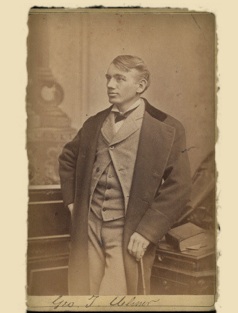
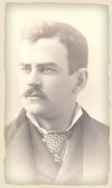
                      George Ulmer    vs.     W.S. Harkins

Today’s soap operas have nothing on 19th century melodrama.  On March 14,1877 Lizzie May’s troupe performed a play titled Ben McCulloch or Sartin as Death.  It’s a strange title and after a week of research I have found no information about the play except a review from the Acadian Recorder newspaper from March 14,1907.

Ben McCulloch (1811-1862) was an actual person who lived a very colorful life. He was a  Texas Ranger, a Sheriff, a good friend to           Davy Crockett, a Prospector during the 1849 Gold Rush and finally a Confederate General killed during a Civil War battle in 1862. The play which I believe is based on his life certainly had enough drama to draw from!

According to The Acadian Recorder dated March 14, 1907, 30 years ago the play at The Academy was Ben McCulloch or Sartin as Death. The main character was played by Oliver Dowd Byron making his first appearance in Halifax.

The reviewer writes ” Ben McCulloch is practically one of Buffalo Bill‘s blood and thunder stories dramatized, and from the beginning to end there is no cessation of interest. the lynching mob, the burning swelling, the daring rescue, the villainous plot, the robbery, the state prison, the mad Ben, the churchyard in the storm with it’s premature graves, the attempted murder, the exciting recontre, the touching meeting after long years of wasting sorrow, were the composites of the play.

George who fancied himself to be a looker must have been annoyed by the rest of the review regarding a young actor named W.S. Harkins.

W.S. Harkins is alleged to be the best looking member of the Nannary Company. it has been said that several impressionable young women in the city have fallen in love with him, and that the Academy of Music audiences have been augmented in consequence“.

Sorry George, that’s got to hurt the ego! Lizzie May does not receive a specific mention but as this is a root ’em toot ’em masculine play her role was most likely a small one as damsel in distress or saloon girl.

You decide. Check out the photos of George and W.S. . Who do you think would make the girls swoon?
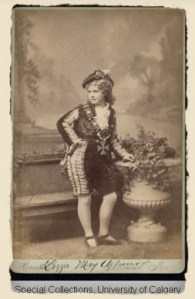
The Challenge

Finding all the pieces of this jigsaw puzzle to create the picture of a woman who lived so long ago can be a challenging and yes, frustrating venture.

Lizzie May Ulmer lived over 150 years ago. Based on reviews of her work, she was a very good actress however she was never to make such a mark on the stage as to be recognizable to today’s theatre buff. Perhaps that is why I write about her. Lizzie May lived a life that we can only imagine. She lived through the Civil War, the Industrial Revolution and the advance of the railroad. She lived through a change in this country the likes of which we will most likely never see again. Strong-willed, she chose an  unusual path for a woman of the time. By choosing a career on the stage she took control of her life in the only way that a woman of the late 1800’s could. Actresses traveled, handled their accounts and lived with more freedoms than most women of the Age. That alone speaks volumes about the type of woman that Lizzie May was.

When we last left Lizzie May and her husband  George they had survived one of the worst fires in Canadian history , literally escaping with the clothes on their backs. They headed back to Boston to recover and decide on their future.

Please join me as I continue on my quest to remember a woman who lived a life well lived.

The Stage

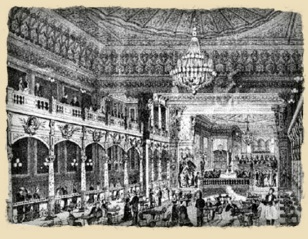
Koster & Bial’s Music Hall on 23rd street in Manhattan, the premier variety house of the late 19th century.

The second half of the 19th Century was an exciting time for the theatre. After the Civil War there was a huge influx of immigration and an enormous growth was seen in America’s cities, in particular cities on the East Coast such as Boston and New York. With the onstart of the Industrial Revolution, the growth of factories and increased productions, the continued hysteria around the Gold Rush, everything pointed to prosperity and growth for a class of people that became known as the Middle Class. Americans now had a better standard of living than ever before and with that, discretionary income to spend on entertainment.

Thanks to the expansion of the transportation system in the U.S., in particular the railroads which linked East Coast to West , actors were able to travel across America finally reaching towns that had never experienced any form of theatre before. Thousands of theaters popped up across the U.S. between 1850-1900. The growth of theatre brought an entire new cache of jobs from costumers to dramatic agencies to boarding houses and hotels who catered specifically to the trade.

Once no more than bare bones music halls soon morphed into beautiful, intricately designed theaters. The lavish productions against the backdrop of these elegant theaters became the ultimate from of entertainment.

Theater design and technology changed as well around the mid-19th century. Candlelit stages were replaced with gaslight and limelight. Limelight consisted of a block of lime heated to incandescence by means of an oxyhydrogen flame torch. The light could then be focused with mirrors and produced a quite powerful light. Theater interiors began improving in the 1850s, with ornate decoration and stall seating replacing the pit. In 1869, Laura Keen opened the remodeled Chestnut Street Theater in Philadelphia, and newspaper accounts describe the comfortable seats, convenient boxes, lovely decorations and hangings, excellent visibility, good ventilation, and baskets of flowers and hanging plants.

Theater crowds in the first half of the 19th century had gained a reputation as unruly, loud and uncouth. The improvements made to theaters in the last half of the 19th century encouraged middle and upper class patrons to attend plays, and crowds became quieter, more genteel, and less prone to cause disruptions of the performance.

The lure of the theatre was too much for George. He spent all of his free time visiting the multitude of music halls and theaters throughout Boston. At the Selwyn Theatre on Washington Street George was able to charm his way into bit parts in small productions. It felt like home and this new home was heaven.

Next Up:  A Surprise

Washington Street

Above: Actor John H Selwyn who would open The Selwyn Theatre in 1867.

In 1868 Charley Ulmer was running a small job printing plant on Washington Street in Boston. Younger brother George was Charley’s apprentice but he became increasingly distracted by a new theatre that had opened just down the street. Washington Street in the mid to late 19th century was the center of commerce and cultural events for Boston’s south end. In other words, it was the place to be!

In late 1867, John H. Selwyn a scenic artist with the famed Boston Theatre Company struck out on his own and opened up The Selwyn Theatre at 364 Washington Street. The Selwyn Theatre was a stock company that existed for only three years from the end of 1867-1870. At the time, it was renowned for bringing the most distinguished actors and productions of the day to Boston. George was hooked.

The history of Boston’s theaters often provides the researcher and theater aficionado with some fascinating drama of its own. In the nineteenth century, when Boston was the center of a thriving community of theaters, an ongoing conflict between artistic freedom and the city’s ubiquitous Puritan strain was clearly in evidence. Even as early as the eighteenth century, theater going in Boston was regarded as a fashionable, but not entirely legal pursuit.

A quaint example of Boston’s secret love-affair with the theater is witnessed in the names of early playhouses such as Exhibition Hall and the beloved Boston Museum, which really were theaters in very thin disguise. Indeed, the term “banned in Boston” was one used either pejoratively by theater lovers.

George had been bitten by the acting bug while convalescing in Balfour Hospital during the Civil War. He was entranced by the theatre. Soon he had cajoled his way into bit parts. The actors, the costumes, the audience clapping…it all appealed to our ham-ish hero.

Next Up: The Stage

What’s next for George?

Above: a great photo of George from the George Stewart Collection

George basked in the glory of a hero’s welcome home. His family showered him with attention, patiently listening to his stories over and over again. He writes in his memoirs about his young step-sister Lizzie following him everywhere. She never tired of his enthusiastic ramblings and became a sounding board for his dreams of a big future.

For George, the War had opened his eyes to new places, new people and new experiences. He longed to get out and make a name for himself. A U.S. Tax assessment record from February of 1866 shows 16 year old George running his own “gift enterprise company” by the name of George T. Ulmer & Co. The tax assessment was $833.00. What he was doing is anyone’s guess. His charm and easy gift for gab probably made him an excellent salesman! No moss was growing on George’s stone.

In 1868 Charley married Laura and opened a small job printing plant on Washington Street in Boston. George  joined his big brother as an assistant, enjoying the sights and sounds of a bustling city. The Ulmer brothers were big dreamers and soon Charley was ready for a new venture. He  looked West for an exciting new future in an ever expanding America. After leaving Boston he published newspapers in both Denver and Pueblo, Colorado. By 1870 the driven and already successful Charley had moved his wife Laura, 2 year old son Philip and 5 month old baby boy to Chicago. It is here that I found the next official record of George.

George T Ulmer now 21 is listed on the 1870 Census as living in Chicago Ward 5 with Charley and Laura. George’s occupation is listed as “Printer” and the value of his estate is listed as $3,000.

Five years after the Civil War ended the inseparable Ulmer brothers were still together.

Next Up: Washington Street

Charley

The Army of the Potomac Paraded Down Pennsylvania Avenue
at the end of the Civil War. May 23, 1865. Library of Congress

What happened to our fearless Charley Ulmer after the Civil War?

First thing of course was to go back home to Maine and spend time with his family. But Charley did not rest on his laurels and fade into obscurity, he had the big dreams of a man who had cheated death and lived to tell the tale.

Back in 1858 at fifteen, Charley had published the Bunker Hill Grammar School paper which he called “The Charlestown Newsboy”. With money he earned on the farm he bought the best printing equipment he could afford and spent his free time teaching himself printing methods. He most likely learned a lot from his father who may have been a newspaper man himself.

Charley took his newspaper prowess with him to war. He brought part of his printing equipment with him, using it to print orders for his regiment and cards for his fellow soldiers to send home. Now that the War which had consumed his life for 3 years was over, he was free to pursue his passion for printing.

He also pursued a young woman who he had fallen for under unusual circumstances. As his brother George explained in his memoirs:

During the war,our soldiers would often receive little useful articles, such as stockings, shirts, etc., made by the ladies who formed themselves into societies all over the country and furnished these things for distribution among the soldiers at the front. The young ladies had a great craze at that time of marking their names or initials upon whatever they made. One day my brother received a pair of hand-knit stockings with a little tag sewed on each of them, and written on the tags the letters L. A. D., Islesboro, Maine. They were so acceptable at the time that he declared that if he lived to get out of the army, he would be “gorramed” if he didn’t find the girl that built those stockings, and kiss her for them. He began writing to Islesboro, making inquiries, and received several letters signed “Tab.” He was determined not to give it up, however, and when mustered out, the first thing he did, was to go to Islesboro, Maine, to find “Tab.” He found her, she was a schoolma’m, and soon after married her, and they are now living way out in Port Angeles in the State of Washington happy as bugs in a rug, and every meal time you can find several little “Tabs” around the table, some large enough to tell the story of how Pa found Ma, and a great desire to try the same thing themselves. 

The woman was named Laura and she and Charley were married in 1868. By all accounts the marriage was a happy and busy one, they had 5 sons and 2 daughters!

Next Up: What next for George?

Homeward Bound

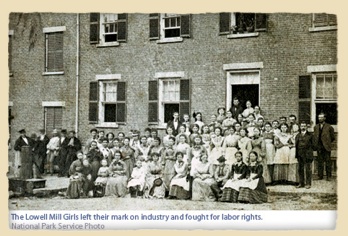
National Parks service photo of a factory in Lowell,MA.

Unlike the lucky Ulmer brothers, so many other brothers did not return home. The list is extensive however I felt the need to include a few examples of those courageous men who died together on the battlefields:

Confederate soldiers and brothers Moses J. Hoge and A. Whitlock Hoge ages 21 and 29 were killed on the same night at the bloody Battle of Cloyd’s Farm  on May 9,1864.

A private cemetery in Taylor Co, Ga. shows 3 of 4 Carson brothers, all Confederate soldiers who were killed in battle or died of their wounds leaving the 4th brother to return home alone.

Brothers Edwin and Henry Lee from the 11th Connecticut Infantry were both killed in the War, Henry leaving behind a wife and four children.

Also from Connecticut, the three Wadman brothers died in battle in Virginia in the summer of 1864. Brothers Alvin and George Flint and their father Alvin Sr. also perished at this time.

The Civil War ended on April 9, 1865. Civil War experts estimate the loss of lives at between 620,000-700,000. The Eighth Maine Volunteer infantry Regiment lost 381 men, 247 of which died from disease. With a population of 31,443,000 people in 1860, this means that close to 2% of the population was killed in the Civil War. Compare that number with today’s War on Terror where around 5,500 have been killed, with our current population of 294,043,000: this translates to  less than .oo2%. The Civil War was responsible for more deaths per population than ANY OTHER WAR in U.S. history. The sheer number of families who lost their beloved sons, husbands and fathers is mind boggling.

The anguish back home resonated for years as widows struggled to somehow manage life without their men. Poverty became a reality and many women left the farms desperate to provide for their families by working in factories in big cities. It was the rise of the Industrial Revolution. In 1870, only two American cities held populations of more than 500,000 but only 30 years later by 1900, there were six, and  New York, Chicago, and Philadelphia each had over one million inhabitants. Soon, approximately 40% of Americans lived in cities and the number was climbing.

The entire country was shifting and changing. There was excitement and hope. Railroads were expanding travel all the way to California and our unscathed Ulmer boys were ready to take on the world. Please continue to follow this lively family as they traverse the U.S., triumph on the stage, become playwrights and newspaper magnates and live life to it’s fullest.

Next Up: Charley’s Bride

War is Over

There was no decisive battle, no grand gesture that suddenly ended the Civil War. The beginning of the end began in late 1864 when Generals Ulysses S. Grant and William Tecumseh Sherman created a strategy of War intended to destroy the spirit of the South. Called the March to the Sea, union battalions swept through the south, destroying Atlanta and Columbia, terrorizing innocent civilians in their wake. Public buildings were looted and burnt. Private homes were not exempt from  the destruction. Think Tara in Gone With the Wind, which the author Margaret Mitchell based on local plantations in Jonesborough,Ga.

After the South’s huge losses during Grant’s Overland Campaign through Virginia, the Confederate Army barely had enough men left to fight. Food and money were in scarce supply and starving and disgusted Confederate soldiers tired of being marched to their deaths soon began deserting in massive numbers.

On April 9, 1865, General Robert E. Lee surrendered his Army  to General Ulysses S. Grant at the McLean House in Appomattox Court House, Virginia. 

On June 30,1865 after more than 660 days as a Union soldier and just 16, a young but world weary George T. Ulmer  was honorably discharged from the Union Army. Happily, his brother Charley now 21, was discharged after being promoted to Full 2nd Lieutenant. Both brothers served their country bravely, with honor and even humor. There are so many heart breaking Civil War stories of brothers dying side by side on the battlefield. It is with a sigh of relief that I can report that George and Charley were able to finally go home to their quiet corner in Maine.

Next Up: Going Home


A Familiar Face

We last saw George playing hooky and puffing away on a cigar down at the steamboat landing at Fortress Monroe.  He had been spotted by a young officer arriving on a small cutter that was bringing a group of sailors from a large ocean steamer to the wharf. It was clear that the officer was not pleased to see George lazily sitting there blatantly breaking the rules.

The cutter hit the edge of the stair sending the standing officer flying backwards off the cutter. George roared with laughter clapping his hands and drawing more attention to himself. The now red-faced Officer tried to regain his balance but when he put his foot on the stair, slimey and wet from the tide, he went head over heels into the water.

When he came back to the surface covered in mud and seaweed, it was too much for George who by now was holding his sides. The other sailors had joined in on the laughter only to be screamed at by the incensed officer. He then turned his anger to George but still George could not stop himself from laughing, by now the tears streaming down his face.

In George’s memoirs he writes:

Hurriedly but cautiously climbing the slippery stairs, he made his way straight for me. I was still laughing, so hearty that my eyes were dimmed with tears! but I still puffed away at the big cigar.

He looked at me for a moment, then hitting the cigar knocked it overboard, at the same time exclaiming, “You’re too young to smoke. What you laughing at? Why don’t you salute me? Discipline! I’ll teach you discipline, confound you,” at the same time boxing my ears.

“You ‘gorramed’ little cuss, why don’t you salute me?” At the word “Gorrame” I recovered myself, looked up and recognized my brother; he had been promoted since I saw him, had raised a full beard and was in command of a regiment on his way to New Orleans and had run into Fortress Monroe for orders. I was more than pleased to see him, but wouldn’t salute him until he had soundly cuffed my ears and threatened to throw me into the water.

It was Spring of 1865 and the Ulmer brothers were re-united.

Next Up: War is Over

A Good Day Ruined

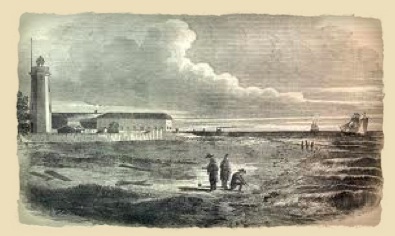
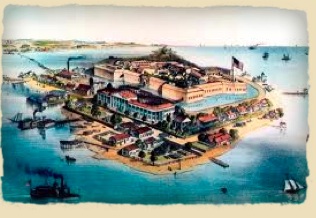
NOTE: Fort Monroe, VA was officially closed by the U.S. Army yesterday , September 15,2011 after 188 years of Army service. The Fort was handed over to the state of Virginia. The Fort, has more than 170 historic buildings, 565 acres and a significant Civil War history. There is hope that there will be a creation of a new National Park which is being evaluated by a bipartisan group in Congress and the National Park Service.

This is the 20th post in the Me and Lizzie May series. What started as just an inquisitive look into the maker of an antique steamer trunk has since morphed into a fascinating portal to the past. Lizzie, George and Charley Ulmer had all but been forgotten and yet they were stalwart, adventurous people who lived very interesting lives and in their own ways were a part of the history of this country. Cheer on George and Charley as we near the end of the War of the States and fervently hope for their survival.

After an emotional week with Confederate President Jefferson Davis, George spent his days running errands for Lieutenant Russell at and around Fortress Monroe. He was soon well known around the Fort as he was generous with his cigars bought with the additional eight dollars per month he had been detailed for the printing job. He made a mess of that job but happily still kept the salary.

One beautiful day he sat pensively smoking a new cigar without a care in the world ignoring all the commotion down at the wharf. Soon he saw for himself what all the noise was about as a huge ocean steamer came into sight and dropped anchor. The Union Captain signaled  and soon a small boat full of sailors was lowered and rowed to shore. The Officer at the stern barked one order after the other ruining George’s peaceful moment with his cigar. When they reached the wharf , the pompous Officer shielding his eyes from the strong afternoon sun pointed at George with a frown on his face.

Uh-Oh. It was strictly prohibited to smoke on the wooden wharf for obvious reasons. Up until now George had not bothered to follow any rules and had got along just fine. He puffed away in defiance pushing away the nagging feeling that the Officer looked vaguely familiar…

Next Up: A Familiar Face