Exciting news

While researching the life of Lizzie May Ulmer, a somewhat famed actress from the late nineteenth century, an idea started to formulate in my mind. It sounded as if it would make a great fiction novel! And so, I have been working on my first book Me and Lizzie May – Forgotten. I am in the home stretch of my first draft and hope to finish it this year.

Stay tuned for more info and more posts as time allows and as always, thank you for reading.

May the best man win…best looking that is!

george t

                                                                                      HW HARKIN

                      George Ulmer    vs.     W.S. Harkins

Today’s soap operas have nothing on 19th century melodrama.  On March 14,1877 Lizzie May’s troupe performed a play titled Ben McCulloch or Sartin as Death.  It’s a strange title and after a week of research I have found no information about the play except a review from the Acadian Recorder newspaper from March 14,1907.

Ben McCulloch (1811-1862) was an actual person who lived a very colorful life. He was a  Texas Ranger, a Sheriff, a good friend to           Davy Crockett, a Prospector during the 1849 Gold Rush and finally a Confederate General killed during a Civil War battle in 1862. The play which I believe is based on his life certainly had enough drama to draw from!

According to The Acadian Recorder dated March 14, 1907, 30 years ago the play at The Academy was Ben McCulloch or Sartin as Death. The main character was played by Oliver Dowd Byron making his first appearance in Halifax.

The reviewer writes ” Ben McCulloch is practically one of Buffalo Bill‘s blood and thunder stories dramatized, and from the beginning to end there is no cessation of interest. the lynching mob, the burning swelling, the daring rescue, the villainous plot, the robbery, the state prison, the mad Ben, the churchyard in the storm with it’s premature graves, the attempted murder, the exciting recontre, the touching meeting after long years of wasting sorrow, were the composites of the play.

George who fancied himself to be a looker must have been annoyed by the rest of the review regarding a young actor named W.S. Harkins.

W.S. Harkins is alleged to be the best looking member of the Nannary Company. it has been said that several impressionable young women in the city have fallen in love with him, and that the Academy of Music audiences have been augmented in consequence“.

Sorry George, that’s got to hurt the ego! Lizzie May does not receive a specific mention but as this is a root ’em toot ’em masculine play her role was most likely a small one as damsel in distress or saloon girl.

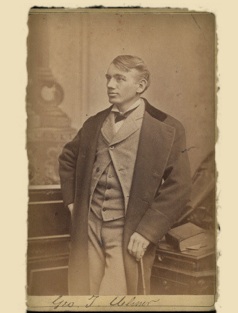
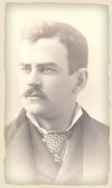
You decide. Check out the photos of George and W.S. . Who do you think would make the girls swoon?

Choosing An Actor’s Life

For young newlyweds George and Lizzie May to choose acting as their professions in the late 19th century was a true leap of faith. There were probably many arguments on the subject in the Ulmer household but as we saw during the war, George had a mind of his own and the drive and determination to do as he saw fit. The life of an actor was always in flux and required incredible physical and emotional strength. There was certainly no stability in the life they chose but being together must have been all the support they needed.

The varied performance schedule must have been exhausting. Most actors rehearsed 2-3 plays per day on top of their actual performances. A season could consist of anywhere from 40 to over 100 different plays. Stock actors such as Lizzie May and George would be expected to learn over 100 parts, many times having to memorize a new role in a matter of hours. The life of a “celebrated” actor was no less rigorous. One famous actress of the day Charlotte Cushman, had over 200 roles in her repertoire making her a sought after commodity. Big names brought in big crowds to the local stock theatre companies.

Luckily,compensation for this grueling life was actually fairly good by late 19th century standards. According to an essay on 19th century American theatre from the University of Washington:

Beginning actors’ salaries ranged from $3 to $6 per week; utility players’ salaries from $7 to $15 per week; “walking” ladies and gentlemen, $15 to $30; and lead actors were paid anywhere from $35 to $100 per week. Traveling stars could command $150 to $500 per 7- to 10-day engagement, plus one or more benefits. Except for the lowest ranks of actors, these salaries were good for this period, especially for women, even though they were paid less than men in comparable roles.

From young Civil War drummer boy to stage actor, George was following his dreams and bringing Lizzie May along for the ride.

Would Lizzie May decide to go back home to the quiet corner of Maine or follow her George through the uncertain world of the theatre?

Next Up: Role reversal

What’s next for George?

Above: a great photo of George from the George Stewart Collection

George basked in the glory of a hero’s welcome home. His family showered him with attention, patiently listening to his stories over and over again. He writes in his memoirs about his young step-sister Lizzie following him everywhere. She never tired of his enthusiastic ramblings and became a sounding board for his dreams of a big future.

For George, the War had opened his eyes to new places, new people and new experiences. He longed to get out and make a name for himself. A U.S. Tax assessment record from February of 1866 shows 16 year old George running his own “gift enterprise company” by the name of George T. Ulmer & Co. The tax assessment was $833.00. What he was doing is anyone’s guess. His charm and easy gift for gab probably made him an excellent salesman! No moss was growing on George’s stone.

In 1868 Charley married Laura and opened a small job printing plant on Washington Street in Boston. George  joined his big brother as an assistant, enjoying the sights and sounds of a bustling city. The Ulmer brothers were big dreamers and soon Charley was ready for a new venture. He  looked West for an exciting new future in an ever expanding America. After leaving Boston he published newspapers in both Denver and Pueblo, Colorado. By 1870 the driven and already successful Charley had moved his wife Laura, 2 year old son Philip and 5 month old baby boy to Chicago. It is here that I found the next official record of George.

George T Ulmer now 21 is listed on the 1870 Census as living in Chicago Ward 5 with Charley and Laura. George’s occupation is listed as “Printer” and the value of his estate is listed as $3,000.

Five years after the Civil War ended the inseparable Ulmer brothers were still together.

Next Up: Washington Street