Charley

The Army of the Potomac Paraded Down Pennsylvania Avenue
at the end of the Civil War. May 23, 1865. Library of Congress

What happened to our fearless Charley Ulmer after the Civil War?

First thing of course was to go back home to Maine and spend time with his family. But Charley did not rest on his laurels and fade into obscurity, he had the big dreams of a man who had cheated death and lived to tell the tale.

Back in 1858 at fifteen, Charley had published the Bunker Hill Grammar School paper which he called “The Charlestown Newsboy”. With money he earned on the farm he bought the best printing equipment he could afford and spent his free time teaching himself printing methods. He most likely learned a lot from his father who may have been a newspaper man himself.

Charley took his newspaper prowess with him to war. He brought part of his printing equipment with him, using it to print orders for his regiment and cards for his fellow soldiers to send home. Now that the War which had consumed his life for 3 years was over, he was free to pursue his passion for printing.

He also pursued a young woman who he had fallen for under unusual circumstances. As his brother George explained in his memoirs:

During the war,our soldiers would often receive little useful articles, such as stockings, shirts, etc., made by the ladies who formed themselves into societies all over the country and furnished these things for distribution among the soldiers at the front. The young ladies had a great craze at that time of marking their names or initials upon whatever they made. One day my brother received a pair of hand-knit stockings with a little tag sewed on each of them, and written on the tags the letters L. A. D., Islesboro, Maine. They were so acceptable at the time that he declared that if he lived to get out of the army, he would be “gorramed” if he didn’t find the girl that built those stockings, and kiss her for them. He began writing to Islesboro, making inquiries, and received several letters signed “Tab.” He was determined not to give it up, however, and when mustered out, the first thing he did, was to go to Islesboro, Maine, to find “Tab.” He found her, she was a schoolma’m, and soon after married her, and they are now living way out in Port Angeles in the State of Washington happy as bugs in a rug, and every meal time you can find several little “Tabs” around the table, some large enough to tell the story of how Pa found Ma, and a great desire to try the same thing themselves. 

The woman was named Laura and she and Charley were married in 1868. By all accounts the marriage was a happy and busy one, they had 5 sons and 2 daughters!
Next Up: What next for George?

Homeward Bound

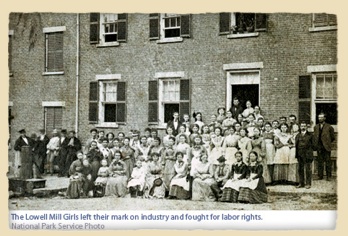
National Parks service photo of a factory in Lowell,MA.

Unlike the lucky Ulmer brothers, so many other brothers did not return home. The list is extensive however I felt the need to include a few examples of those courageous men who died together on the battlefields:

Confederate soldiers and brothers Moses J. Hoge and A. Whitlock Hoge ages 21 and 29 were killed on the same night at the bloody Battle of Cloyd’s Farm  on May 9,1864.

A private cemetery in Taylor Co, Ga. shows 3 of 4 Carson brothers, all Confederate soldiers who were killed in battle or died of their wounds leaving the 4th brother to return home alone.

Brothers Edwin and Henry Lee from the 11th Connecticut Infantry were both killed in the War, Henry leaving behind a wife and four children.

Also from Connecticut, the three Wadman brothers died in battle in Virginia in the summer of 1864. Brothers Alvin and George Flint and their father Alvin Sr. also perished at this time.

The Civil War ended on April 9, 1865. Civil War experts estimate the loss of lives at between 620,000-700,000. The Eighth Maine Volunteer infantry Regiment lost 381 men, 247 of which died from disease. With a population of 31,443,000 people in 1860, this means that close to 2% of the population was killed in the Civil War. Compare that number with today’s War on Terror where around 5,500 have been killed, with our current population of 294,043,000: this translates to  less than .oo2%. The Civil War was responsible for more deaths per population than ANY OTHER WAR in U.S. history. The sheer number of families who lost their beloved sons, husbands and fathers is mind boggling.

The anguish back home resonated for years as widows struggled to somehow manage life without their men. Poverty became a reality and many women left the farms desperate to provide for their families by working in factories in big cities. It was the rise of the Industrial Revolution. In 1870, only two American cities held populations of more than 500,000 but only 30 years later by 1900, there were six, and  New York, Chicago, and Philadelphia each had over one million inhabitants. Soon, approximately 40% of Americans lived in cities and the number was climbing.

The entire country was shifting and changing. There was excitement and hope. Railroads were expanding travel all the way to California and our unscathed Ulmer boys were ready to take on the world. Please continue to follow this lively family as they traverse the U.S., triumph on the stage, become playwrights and newspaper magnates and live life to it’s fullest.

Next Up: Charley’s Bride

War is Over

There was no decisive battle, no grand gesture that suddenly ended the Civil War. The beginning of the end began in late 1864 when Generals Ulysses S. Grant and William Tecumseh Sherman created a strategy of War intended to destroy the spirit of the South. Called the March to the Sea, union battalions swept through the south, destroying Atlanta and Columbia, terrorizing innocent civilians in their wake. Public buildings were looted and burnt. Private homes were not exempt from  the destruction. Think Tara in Gone With the Wind, which the author Margaret Mitchell based on local plantations in Jonesborough,Ga.

After the South’s huge losses during Grant’s Overland Campaign through Virginia, the Confederate Army barely had enough men left to fight. Food and money were in scarce supply and starving and disgusted Confederate soldiers tired of being marched to their deaths soon began deserting in massive numbers.

On April 9, 1865, General Robert E. Lee surrendered his Army  to General Ulysses S. Grant at the McLean House in Appomattox Court House, Virginia. 

On June 30,1865 after more than 660 days as a Union soldier and just 16, a young but world weary George T. Ulmer  was honorably discharged from the Union Army. Happily, his brother Charley now 21, was discharged after being promoted to Full 2nd Lieutenant. Both brothers served their country bravely, with honor and even humor. There are so many heart breaking Civil War stories of brothers dying side by side on the battlefield. It is with a sigh of relief that I can report that George and Charley were able to finally go home to their quiet corner in Maine.

Next Up: Going Home


A Familiar Face

We last saw George playing hooky and puffing away on a cigar down at the steamboat landing at Fortress Monroe.  He had been spotted by a young officer arriving on a small cutter that was bringing a group of sailors from a large ocean steamer to the wharf. It was clear that the officer was not pleased to see George lazily sitting there blatantly breaking the rules.

The cutter hit the edge of the stair sending the standing officer flying backwards off the cutter. George roared with laughter clapping his hands and drawing more attention to himself. The now red-faced Officer tried to regain his balance but when he put his foot on the stair, slimey and wet from the tide, he went head over heels into the water.

When he came back to the surface covered in mud and seaweed, it was too much for George who by now was holding his sides. The other sailors had joined in on the laughter only to be screamed at by the incensed officer. He then turned his anger to George but still George could not stop himself from laughing, by now the tears streaming down his face.

In George’s memoirs he writes:

Hurriedly but cautiously climbing the slippery stairs, he made his way straight for me. I was still laughing, so hearty that my eyes were dimmed with tears! but I still puffed away at the big cigar.

He looked at me for a moment, then hitting the cigar knocked it overboard, at the same time exclaiming, “You’re too young to smoke. What you laughing at? Why don’t you salute me? Discipline! I’ll teach you discipline, confound you,” at the same time boxing my ears.

“You ‘gorramed’ little cuss, why don’t you salute me?” At the word “Gorrame” I recovered myself, looked up and recognized my brother; he had been promoted since I saw him, had raised a full beard and was in command of a regiment on his way to New Orleans and had run into Fortress Monroe for orders. I was more than pleased to see him, but wouldn’t salute him until he had soundly cuffed my ears and threatened to throw me into the water.

It was Spring of 1865 and the Ulmer brothers were re-united.

Next Up: War is Over

A Good Day Ruined

NOTE: Fort Monroe, VA was officially closed by the U.S. Army yesterday , September 15,2011 after 188 years of Army service. The Fort was handed over to the state of Virginia. The Fort, has more than 170 historic buildings, 565 acres and a significant Civil War history. There is hope that there will be a creation of a new National Park which is being evaluated by a bipartisan group in Congress and the National Park Service.

This is the 20th post in the Me and Lizzie May series. What started as just an inquisitive look into the maker of an antique steamer trunk has since morphed into a fascinating portal to the past. Lizzie, George and Charley Ulmer had all but been forgotten and yet they were stalwart, adventurous people who lived very interesting lives and in their own ways were a part of the history of this country. Cheer on George and Charley as we near the end of the War of the States and fervently hope for their survival.

After an emotional week with Confederate President Jefferson Davis, George spent his days running errands for Lieutenant Russell at and around Fortress Monroe. He was soon well known around the Fort as he was generous with his cigars bought with the additional eight dollars per month he had been detailed for the printing job. He made a mess of that job but happily still kept the salary.

One beautiful day he sat pensively smoking a new cigar without a care in the world ignoring all the commotion down at the wharf. Soon he saw for himself what all the noise was about as a huge ocean steamer came into sight and dropped anchor. The Union Captain signaled  and soon a small boat full of sailors was lowered and rowed to shore. The Officer at the stern barked one order after the other ruining George’s peaceful moment with his cigar. When they reached the wharf , the pompous Officer shielding his eyes from the strong afternoon sun pointed at George with a frown on his face.

Uh-Oh. It was strictly prohibited to smoke on the wooden wharf for obvious reasons. Up until now George had not bothered to follow any rules and had got along just fine. He puffed away in defiance pushing away the nagging feeling that the Officer looked vaguely familiar…

Next Up: A Familiar Face

George and the President

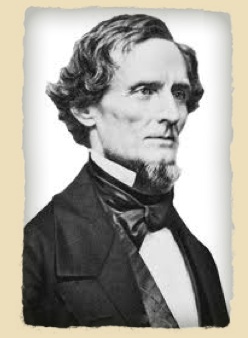
From February 16,1861 through May 5, 1865 Jefferson Davis was the elected President of the Confederate States. Even though his appearance was shockingly similar to that of President Abraham Lincoln, he was by most accounts an ineffective war strategist and his lack of popular appeal made sure that any similarities ended there. Historically he has been called meddlesome, difficult to work with and controlling.

Young George Ulmer had a completely different view of the man. After his printing debacle, George was re-assigned to a task he was well suited to. Cheerful, optimistic, friendly George was assigned as a type of guard to Jefferson Davis while the Confederate President was incarcerated at Fortress Monroe. He was instructed to accompany the President on his daily walks and generally keep the man company.

For a full week he walked and talked with the President listening to his woes and of course asking plenty of questions. George had nothing negative to say about his assignment in fact ,the opposite is true. In his memoirs he writes:

 He gave me lots of good advice, and I learned more from conversation with him about national affairs than I ever expected to know; and if I ever become president I will avail myself of the advice and teaching of that great man. He pointed out the right and wrong paths for young men; urged me above all things to adhere strictly to honesty and integrity; to follow these two principles, and I would succeed in business and become great and respected. I thanked him for his kind advice, and pressed his hand good-bye. “Good-bye, my boy,” said he. “You have been a comfort to me in my loneliness and sorrow. God bless you, my boy, God bless you!” A great, big something came up in my throat as I turned and left him, and I have regretted all my life that I was not fortunate enough to have the pleasure of meeting him again before he passed away; for I assure you, indulgent readers and comrades, that no matter what he had done, or what mistakes he had made, his memory will always find a warm spot in the heart of that little Drummer Boy from Maine. 

Next Up: A Good Day Ruined

Fortress Monroe

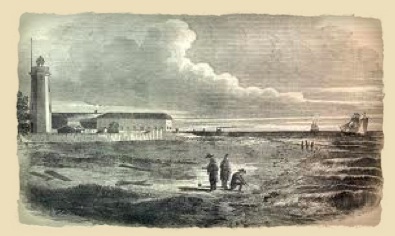
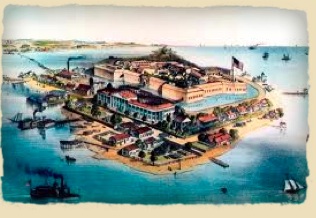
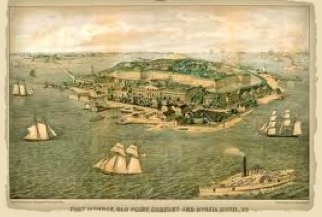
After an enjoyable few weeks assigned to light duty with the Veteran Reserves corps., George was transferred to Fortress Monroe, a military installation in Hampton,Virginia at the southern tip of the Virginia Peninsula. Fort Monroe guarded the channel between the Chesapeake Bay and Hampton Roads. This impenetrable six-sided stone fort was completely surrounded by a moat. 

It must have daunting for George to have been assigned to this imposing stone fortress. After reporting in to headquarters he wandered the grounds for a bit to get his bearings. He soon found a worn stone wall and sat down to enjoy a cigar (his new vice). This was the busiest base he had been at and there was a lot to see. Soon enough he was discovered sitting there and told to move on and get his orders. He found his superior, Lieutenant Russell who he fondly recalls in his memoirs. Lieutenant Russell needed a foreman in the Government Printing Office. For “occupation” George had filled in “Printer” on his paperwork. Printing however was his father’s profession but George figured he knew all about it so he told the Lieutenant that he “had some knowledge of it”.

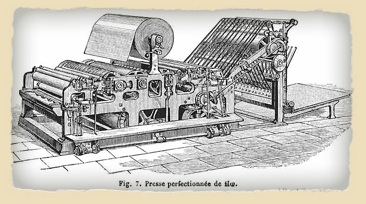
As a Printer, George was given an additional eight dollars per month, a fortune to him! His first assignment was to print 50,000 official envelopes. It was during the Civil War that many advances in printing were invented. Rotary presses were introduced, and in 1863, the Philadelphia Inquirer became the first newspaper to use a web-perfecting press that allowed a man to feed one sheet of paper through the machine and have it print on both sides. These time-saving inventions were a wonder in their day but still a far cry from our current method of keying “print” on the computer!

This picture was taken from Dictionnaire encyclopédique Trousset, also known as the Trousset encyclopedia, Paris, 1886 – 1891.
George spent the next few days printing up 50,000 official envelopes. Job completed, he patted himself on the back and decided to reward his fine work with a cigar and enjoy his day. A breathless Private found him and told him to report to Lieutenant Russell’s office right away. Proud as a peacock he marched into Lieutenant Russell’s office wondering what kind of award or even promotion he would get for his outstanding work. he even imagined  that he would be re-assigned maybe to Washington to take over the Government Printing Office there. At that moment he probably thought that he could single-handedly win the war!

Smiling, the Lieutenant asked him :

“Young man, you told me you were a printer?” 

“Yes, sir.” 

“Did you ‘O. K.’ this job?” passing one of the envelopes he held in his hand. 

“Yes sir,” I answered. 

“Umph! Is it correct?” 

“Yes, sir.” 

“It is, eh?” 

“Yes-s, sir.” 

“Umph! how do you spell business?” 

“B-u-i-s-n-e-ss,” said I. 

“You do, eh?” 

“Yes, sir.” 

“Well,” said he in an imperative manner, “our government sees fit to differ with you. You will go to your office and print fifty thousand more, but see that you spell business right, and bring me the proof. The lot you have printed we will send to Washington, and recommend that they be made into a paper mache statue of yourself, and label it ‘Buisness’.” 

And so began and ended George’s illustrious printing career…at least for now.

Next up: George and the President

Will George Survive?

For over three weeks George recuperated at Balfour the Portsmouth,VA military hospital. He had escaped with relatively minor injuries and a nasty concussion. But once he started feeling better he thoroughly enjoyed being fussed over by the various women’s leagues who visited wounded soldiers. These devoted women would bring books, warm blankets and home-baked treats. Young, charismatic George was soon the center of attention, his favorite place to be.

He bounced back quickly and thoroughly bored with hospital life he had the audacity to write a letter to Secretary of War Edwin M. Stanton. After explaining who he was and how he was faring in the War (including being injured and staying at Balfour Hospital), he asked if he should go back to the front or just go home to his family. He was of course hoping to be sent home. Instead, he received a special order direct from Secretary Stanton himself to have George transferred to the 2nd Battalion Veteran Reserve Corps. This was a coup as this would keep him away from the battlefields.

The title “Veteran Reserve Corps” was substituted for that of “Invalid Corps” by General Order No. 111, dated March 18, 1864. The men serving in the Veteran Reserve Corps were organized into two battalions; the First Battalion including those whose disabilities were comparatively slight and who were still able to handle a musket and do some marching, also to perform guard or provost duty. The Second Battalion was made up of men whose disabilities were more serious, who had perhaps lost limbs or suffered some other grave injury. These later were commonly employed as cooks, orderlies, nurses, or guards in public buildings.

For two months George enjoyed serving in the Veteran Reserve Corps. While most of his fellow battalion were made up of amputees and sick soldiers, he had his strength and vitality giving him ample opportunity to finish his light tasks and leaving a lot of time to roam freely. With his free time George became involved in local theatre. He happily acted in productions for the wounded soldiers at the hospital. His enthusiasm made up for his lack of acting experience and his good nature and quick wit brought good cheer to the suffering soldiers and tired staff.

All in all life was not bad for this Drummer Boy from Maine. Luck as always was on his side.

Next Up: Fortress Monroe

The beautiful sketch above was found at a blog titled: Boys of the Civil War. Well worth the read. The sheer number of soldiers below the age of 18 in the Civil War is astounding.

George Is Injured

When George’s regiment was ordered to march, he decided not to go. The last few weeks had shattered his boyhood illusions of war. He’d had enough. He no longer wanted to be a big hero, he just wanted to go home. Sadly his decision meant that he would part with his brother Charley for the first time. The close brothers shared a tearful good-bye promising to see each other soon.

George  sat on a fence watching his regiment disappear into the horizon. He sat there a while longer than he should have lost in his thoughts. Out of nowhere, shells started raining down on him. The enemy had spotted him. He leaped off the fence ready to bolt like a rabbit when BAM! a splintered section of fence slammed into him knocking him to the ground unconscious.

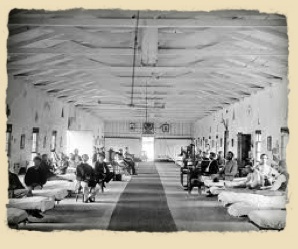
The next thing he knew, he was laying in a hospital bed fuzzy headed and unable to move. He had no recollection of how he got there. The field hospital did not have the capability to care for him so he was transferred  to the main hospital which was set up in the Balfour hotel in Portsmouth,VA. Unable to walk, he was carried into the old dining room which now served as a dormitory for wounded soldiers. There were over 200 iron beds in that room. He was laid down on one of the beds and exhausted soon fell asleep waiting for the doctor.

Hospitals in the 1860’s were nothing like the hospitals of today. In 1863 the government did an inspection of military hospitals that treated Union soldiers. Of the 892 Union hospitals reviewed, 589 received a good inspection but 303 were rated bad to unfit. Of the doctors who were inspected, 2,727 were up to speed on “modern” practices and ranked  o.k. to good but 303 were ranked bad or unacceptable. As bad as the surgeon’s tents on the fields were, the hospitals of the day were not much better. Many soldiers died from either their battle wounds or disease in the hospital.  It was so bad that soldiers considered a trip to the hospital a death sentence. The Union Army lists 67,000 soldiers killed in action plus 43,000 died of battle wounds and a terrifying 248,000 died from mostly from disease. Without antibiotics to curb the spread of bronchitis, infected wounds etc… death was imminent in so many cases. These numbers only reflect the Union which actually had better medical care than the South. The following information from CivilWar.com gives a sobering view about the wounds incurred from Civil War musketry:

When a minie ball struck a bone it almost never failed to fracture and shatter the contiguous bony structure, and it was rarely that only a round perforation, the size of the bullet, resulted. When a joint was the part the bullet struck, the results were especially serious in Civil War days. Of course, the same was true of wounds of the abdomen and head, though to a much greater degree. Indeed, recovery from wounds of the abdomen and brain almost never occurred. One of the prime objects of the Civil War surgeon was to remove the missile, and, in doing this, he practically never failed to infect the part with his dirty hands and instrument.

George awoke to the disheartening sounds of men in pain. Some of these brave soldiers moaned and sobbed softly. Others screamed delirious with pain and worst of all were those who lay silent wrapped in linens dripping with cool water. These were the burn victims and it was a terrible sight to see. He was still fuzzy headed and could not move his legs. The mischievous, friendly young drummer boy we have come to know and root for now lay silent in a hospital bed far from his brother who had protected him, far from his family who loved him.

Would George survive? And if so, in what capacity?

Time Saver

In our daily lives we are always looking to save time. In Charley’s case time saved him.

George was understandably traumatized by his bloody work at the surgeon’s tent. Afterwards he shirked all official duties focusing instead on scavenging whenever, wherever and whatever he could. Soon the pickings at Petersburg became slim and as his unit was being called to move out, he went to say good-bye to his brother Charley who had been assigned to a new unit. Charley was downtrodden, not at all enthusiastic about yet another march and inevitably another battle. George decided he would go on one last foraging mission in search of a special good-bye treat for his big brother.

Wherever there were soldiers there were laypeople selling their wares from knitted socks to home-made cakes and pies. These brave (or crazy) men would fill up their wagons and drive right up to the front on the days they knew that the men got paid. On this day a ragged old man with a wagon fixed out with a stove was selling fresh hot mince pies. The smell alone was making the men drool. For each man lucky enough to get one there were ten or more standing around wistfully watching him eat it. After analyzing the situation up and down and realizing that theft was not an option with such a crowd, George ran as fast as he could back to his brother to beg for $1. Charley had no money at all and his sorrow was written all over his war worn face. George sat down next to him and thought through all his scavenging tricks. He had to get his brother one of those pies.

He recounts:

Charley, my brother, owned an old-fashioned silver watch, one of those old “English levers.” He thought a great deal of it as a keep-sake and always gave it to me to keep when he was going into action. I had this watch now, and made up my mind I would trade it and get a lot of pies for us all. Oh! such bright anticipations of hot mince pies. I could almost see them floating in the air as big as cart wheels, and fearing they would all be sold before I could reach the wagon, I ran as hard as I could. The crowd had thinned out and so had the pies. “How many have you got left?” I eagerly asked. 

“Oh, plenty,” he replied; “how many, do you want?” “Well,” I said, nearly out of breath, “I haven’t any money, but I want all you have, and I’ll trade you a nice watch for them.” 

“Say, cully! what yer givin’ me? I don’t want no watch. Let’s see it.” 

I quickly passed it up to him, and stood working my fingers and feet impatiently and revolving in my mind how many pies he would give me and how I would manage to carry them back, when he broke out into a loud, contemptuous laugh, and passed the watch back. 

“Say, young fellow, that aint no good. I’d rather have a blacking box than that thing.” 

“It’s silver,” I replied. 

“That don’t make no difference. I’ll give you one pie for the thing if you want it, see!” 

I turned the watch over and over in my hand, my feelings hurt and my stomach disappointed. Then I thought of my brother, forgot that it was his high-priced time-piece, and quickly said: 

“Give me the pie and take the watch.” 

Of course once the pie was greedily devoured down to the last crumb Charley started to ask questions as to how George had managed to get the pie with no money. Eventually he guiltily confessed that he had traded Charley’s prized silver watch. The disappointment in Charley’s eyes broke his heart. Determined to get it back he ran back to the pie man and  convinced him that he could show him how the complicated watch worked in exchange for a ride. George slowly set the time and wound the watch stalling so that he could come up with some way to get it back. He knew he couldn’t just bolt with it with so many soldiers around. Suddenly a shell exploded very close scaring the already skittish horse and overturning the wagon. Lucky George slipped away in the confusion returning the watch to his grateful brother.

Some of George’s luck must have rubbed off on that watch. That evening a fierce battle erupted. Charley was slightly wounded by shells and shrapnel but the one bullet that would have killed him was deflected by his silver watch. His watch was shattered but Charley was fine. Charley kept the fragments of that watch with him for the rest of the war. It really was a time saver.

Next Up:  George is injured, will he survive the War?