What’s next for George?

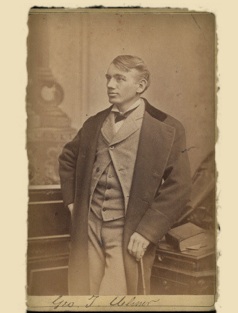
Above: a great photo of George from the George Stewart Collection

George basked in the glory of a hero’s welcome home. His family showered him with attention, patiently listening to his stories over and over again. He writes in his memoirs about his young step-sister Lizzie following him everywhere. She never tired of his enthusiastic ramblings and became a sounding board for his dreams of a big future.

For George, the War had opened his eyes to new places, new people and new experiences. He longed to get out and make a name for himself. A U.S. Tax assessment record from February of 1866 shows 16 year old George running his own “gift enterprise company” by the name of George T. Ulmer & Co. The tax assessment was $833.00. What he was doing is anyone’s guess. His charm and easy gift for gab probably made him an excellent salesman! No moss was growing on George’s stone.

In 1868 Charley married Laura and opened a small job printing plant on Washington Street in Boston. George  joined his big brother as an assistant, enjoying the sights and sounds of a bustling city. The Ulmer brothers were big dreamers and soon Charley was ready for a new venture. He  looked West for an exciting new future in an ever expanding America. After leaving Boston he published newspapers in both Denver and Pueblo, Colorado. By 1870 the driven and already successful Charley had moved his wife Laura, 2 year old son Philip and 5 month old baby boy to Chicago. It is here that I found the next official record of George.

George T Ulmer now 21 is listed on the 1870 Census as living in Chicago Ward 5 with Charley and Laura. George’s occupation is listed as “Printer” and the value of his estate is listed as $3,000.

Five years after the Civil War ended the inseparable Ulmer brothers were still together.

Next Up: Washington Street

Charley

The Army of the Potomac Paraded Down Pennsylvania Avenue
at the end of the Civil War. May 23, 1865. Library of Congress

What happened to our fearless Charley Ulmer after the Civil War?

First thing of course was to go back home to Maine and spend time with his family. But Charley did not rest on his laurels and fade into obscurity, he had the big dreams of a man who had cheated death and lived to tell the tale.

Back in 1858 at fifteen, Charley had published the Bunker Hill Grammar School paper which he called “The Charlestown Newsboy”. With money he earned on the farm he bought the best printing equipment he could afford and spent his free time teaching himself printing methods. He most likely learned a lot from his father who may have been a newspaper man himself.

Charley took his newspaper prowess with him to war. He brought part of his printing equipment with him, using it to print orders for his regiment and cards for his fellow soldiers to send home. Now that the War which had consumed his life for 3 years was over, he was free to pursue his passion for printing.

He also pursued a young woman who he had fallen for under unusual circumstances. As his brother George explained in his memoirs:

During the war,our soldiers would often receive little useful articles, such as stockings, shirts, etc., made by the ladies who formed themselves into societies all over the country and furnished these things for distribution among the soldiers at the front. The young ladies had a great craze at that time of marking their names or initials upon whatever they made. One day my brother received a pair of hand-knit stockings with a little tag sewed on each of them, and written on the tags the letters L. A. D., Islesboro, Maine. They were so acceptable at the time that he declared that if he lived to get out of the army, he would be “gorramed” if he didn’t find the girl that built those stockings, and kiss her for them. He began writing to Islesboro, making inquiries, and received several letters signed “Tab.” He was determined not to give it up, however, and when mustered out, the first thing he did, was to go to Islesboro, Maine, to find “Tab.” He found her, she was a schoolma’m, and soon after married her, and they are now living way out in Port Angeles in the State of Washington happy as bugs in a rug, and every meal time you can find several little “Tabs” around the table, some large enough to tell the story of how Pa found Ma, and a great desire to try the same thing themselves. 

The woman was named Laura and she and Charley were married in 1868. By all accounts the marriage was a happy and busy one, they had 5 sons and 2 daughters!

Next Up: What next for George?

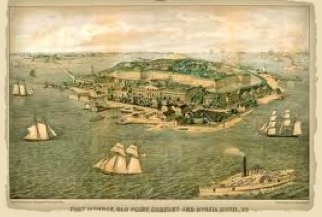
Fortress Monroe

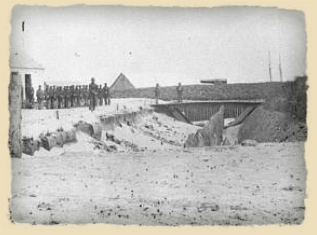
After an enjoyable few weeks assigned to light duty with the Veteran Reserves corps., George was transferred to Fortress Monroe, a military installation in Hampton,Virginia at the southern tip of the Virginia Peninsula. Fort Monroe guarded the channel between the Chesapeake Bay and Hampton Roads. This impenetrable six-sided stone fort was completely surrounded by a moat. 

It must have daunting for George to have been assigned to this imposing stone fortress. After reporting in to headquarters he wandered the grounds for a bit to get his bearings. He soon found a worn stone wall and sat down to enjoy a cigar (his new vice). This was the busiest base he had been at and there was a lot to see. Soon enough he was discovered sitting there and told to move on and get his orders. He found his superior, Lieutenant Russell who he fondly recalls in his memoirs. Lieutenant Russell needed a foreman in the Government Printing Office. For “occupation” George had filled in “Printer” on his paperwork. Printing however was his father’s profession but George figured he knew all about it so he told the Lieutenant that he “had some knowledge of it”.

As a Printer, George was given an additional eight dollars per month, a fortune to him! His first assignment was to print 50,000 official envelopes. It was during the Civil War that many advances in printing were invented. Rotary presses were introduced, and in 1863, the Philadelphia Inquirer became the first newspaper to use a web-perfecting press that allowed a man to feed one sheet of paper through the machine and have it print on both sides. These time-saving inventions were a wonder in their day but still a far cry from our current method of keying “print” on the computer!

This picture was taken from Dictionnaire encyclopédique Trousset, also known as the Trousset encyclopedia, Paris, 1886 – 1891.

George spent the next few days printing up 50,000 official envelopes. Job completed, he patted himself on the back and decided to reward his fine work with a cigar and enjoy his day. A breathless Private found him and told him to report to Lieutenant Russell’s office right away. Proud as a peacock he marched into Lieutenant Russell’s office wondering what kind of award or even promotion he would get for his outstanding work. he even imagined  that he would be re-assigned maybe to Washington to take over the Government Printing Office there. At that moment he probably thought that he could single-handedly win the war!

Smiling, the Lieutenant asked him :

“Young man, you told me you were a printer?” 

“Yes, sir.” 

“Did you ‘O. K.’ this job?” passing one of the envelopes he held in his hand. 

“Yes sir,” I answered. 

“Umph! Is it correct?” 

“Yes, sir.” 

“It is, eh?” 

“Yes-s, sir.” 

“Umph! how do you spell business?” 

“B-u-i-s-n-e-ss,” said I. 

“You do, eh?” 

“Yes, sir.” 

“Well,” said he in an imperative manner, “our government sees fit to differ with you. You will go to your office and print fifty thousand more, but see that you spell business right, and bring me the proof. The lot you have printed we will send to Washington, and recommend that they be made into a paper mache statue of yourself, and label it ‘Buisness’.” 

And so began and ended George’s illustrious printing career…at least for now.

Next up: George and the President

Life or limb?

An amputation tent set up at camp.

The Civil War has been romanticized and re-enacted for years. This subject captures the imagination of scholars and history buffs alike. The amount of information available is mind-boggling. The American Civil War had the most photographic coverage of any conflict of the 19th century and set the stage for the development of future wartime photojournalism.

For the first time, people at home could read the papers and follow the triumphs and devastations. The coverage came complete with grisly photos of their men dying on the battlefields. Photographers like Matthew Brady, Alexander Garner and Timothy O’Sullivan to name a few lived among these soldiers. Their beautiful, heart-breaking photographs show documented proof that war is indeed hell.

In the 1860’s medical care was extremely limited. While today  broken bones and cuts are rarely life threatening, during the Civil War this was not the case. In battle, soldiers were very likely to be seriously wounded at such close combat. Back at camp, disease and poor hygienic conditions were just as likely to cause serious illness or death. Basically, a soldier’s life was a double-edged sword and the Grim Reaper was his ever-present guest. The photojournalists were there to document it all.

In my previous post, I wrote about George’s unlucky friend the Drummer Boy from Pennsylvania. After that soul crushing morning,George was given the assignment to assist in the surgeon’s tent.

These makeshift field hospitals were a dismal place with little hope. Surgeons were basically butchers, sawing off arms and legs that had been shot or stabbed in order to save the soldier from gangrene and other infection. To the left is a photo of a box of surgeon’s tools used at these battlefield medical tents. Just looking at it makes me squeamish. I can’t imagine how a 15 year old boy far from home could find the strength to perform the gruesome task he describes in his memoirs:

In the afternoon I was detailed to wait on the amputating tables at the field hospital. It was a horrible task at first. My duty was to hold the sponge or “cone” of ether to the face of the soldier who was to be operated on, and to stand there and see the surgeons cut and saw legs and arms as if they were cutting up swine or sheep, was an ordeal I never wish to go through again. At intervals, when the pile became large, I was obliged to take a load of legs or arms and place them in a trench near by for burial. I could only stand this one day, and after that I shirked all guard duty. 

According to “The Medical and Surgical History of the War of the Rebellion. (1861-65.)“, ether or chloroform or a combination of the two was used in over 80,00 instances. Wounds festered at an alarming rate on the battlefield. Field doctors were forced to use amputation as a means to stop the spread of infection as antibiotics did not exist yet. It was agreed among field surgeons that the introduction of chloroform and ether was indispensable for saving lives. As the use of chloroform or ether was a relatively new concept and was now being used on such a mass scale, it was a matter of trial and error and some deaths were attributed to it’s use.

After this bloody war, thousands of men returned home shell-shocked and permanently disfigured leaving their limbs behind while so many others even less fortunate left their lives.

Next Up:  Time Saver

George Ulmer’s first Civil War battle

George, age 14 has followed his older brother’s lead and enlisted as a Union soldier in the Civil War. After several weeks as a corporal’s orderly he begs to be sent off to fight. Little did he know what he was asking for. By the end of the war, the Eighth Maine regiment had lost a total of 381 men out of the 1586 who had enrolled. 6 officers and 128 enlisted men were killed or mortally wounded. 4 officers and 243 enlisted men died of disease. Another 355 men were wounded and 35 ended up in confederate prisons.

Blindly, George boarded an open barge heading South. The thought of finding his beloved brother Charley kept him warm on that bitterly cold ride through the Chesapeake Bay. That evening they passed Fort Monroe up the James River and after a restless night they were awoken to the sound of gunfire. They pulled alongside a gunboat whose Captain informed them to land immediately at Fort Powhatan.

They landed on the beach without any weapons as they had not yet met up with their new regiment. They were told that a regiment of 200 African American troops led by Fitzhugh Lee were trying to hold the fort. As George and his fellow recruits had no weapons they were ordered to rush yelling into the thick of the battle in the hopes of making the enemy fear that a huge battalion of recruits had arrived.

George though cut and bleeding was lucky enough to be rescued from the sand by General Smith who made him his orderly. His new position as orderly meant that he had to carry dispatches across the field of battle with bullets whizzing past his small frame.

In his memoirs he writes:

I believe I was so small that I rode between those bullets, and from that time forth I had no fear. I felt as though I were bullet-proof. I felt as if it were ordained that I should go through the war unscathed and unscarred. It did seem so, for I would go through places where it rained bullets, and come out without a scratch. This was my experience all through, and was commented on by comrades, who said I had a charmed life. 

Charmed life or not, George survived his first battle but very quickly his heroic dreams had been tarnished by the realities of war. He and his fellow battle weary survivors were sent downstream towards City Point to finally rendezvous with the Eighth Maine, Company H. At approximately 10:00 that evening they landed on a dark shore with no one to greet them or give them orders. In the distance, gunfire  lit up the night sky. Taking this to be the Front, George heedlessly ran towards the light hoping to have found Charley at last. He writes:

I asked the first man I came to where the Eighth Maine was? He looked at me in perfect astonishment. “This is the Eighth, what’s left of it.” I asked him if he knew where my brother was–Charley Ulmer? “Oh, yes,” he said, and pointing to a little group of men, who were round a wee bit of a fire; “there he is, don’t you know him?” I hesitated, for really I could hardly tell one from the other. He saw my bewilderment, and took me by the arm and led me over to the fire. They all started and stared at me, and to save my life I could not tell which was my brother; but one more ragged than the rest uttered a suppressed cry, rushed forward, and throwing his arm about my neck, sobbed and cried like a child. “My God! my brother! Oh George, George, why did you come here?”  

And so, in the Civil War battle of brother against brother, Lizzie May’s step-brothers had found comfort in each other  so many miles from home. 

Next up, does George’s luck hold?


Saying good-bye

I get a chuckle out of the image of 14 year old George trotting along on his old mare in a state of excited bliss. His chest puffed with pride in his new uniform which was three sizes too big. Pants rolled into his boots, cloak flopping over his saddle, his too large hat obscuring his view as he rode proud as a peacock back to the farm. Just as my boys play dress-up as their favorite superhero, George seemed to be playing dress-up as a soldier.

He arrived home on one of those breathtaking days that only early fall in New England can claim. It was the 17th of September when he rounded the corner to see his family waiting for him. They had been alerted by the stage-driver that George had successfully enlisted and been mustered in.

Lizzie May and her mother had been crying but their tears turned to giggles as they caught sight of their young “soldier”. He looked more like a rag-a-muffin than a soldier, a pile of clothes atop a broken down mare.  They told themselves that no outfit would ever accept him and that George would be sent straight home. Even so, Lizzie continued her plaintive pleas to her favorite step-brother begging him not to go. It was one thing to lose Charley, but George too?

In his memoirs George wrote:

“And father said, after looking me all over:”Well, if they have mustered you in, after they see you in that uniform it will be muster out, my boy”

But George was not only mustered in, he received his orders to report to Augusta,Maine. This just proves how desperate the War had turned. Men were dying in great numbers from battle and disease. New recruits were eagerly sought and immediately sent off.

And so, on September 27th, 1863 George T Ulmer age 14 bid a tearful farewell to his family with his head filled with notions of heroism.

[As an aside, there is a wonderful Civil War Museum in Maine that documents the heroism of George and Charley’s 8th regiment . It is called the Eight Maine Regiment Memorial which is a living museum and lodge. According to their website, the Memorial building was the summer vacation home for veterans of the Civil War who fought in the 8th Maine Regiment as well as their families. William Miltmore McArthur, a Colonel of the Regiment, donated the funds to purchase the land and to build the hall]
Please visit their website for more information. 

Lizzie May, age 6

Imagine the year is 1861. The place is New York City.
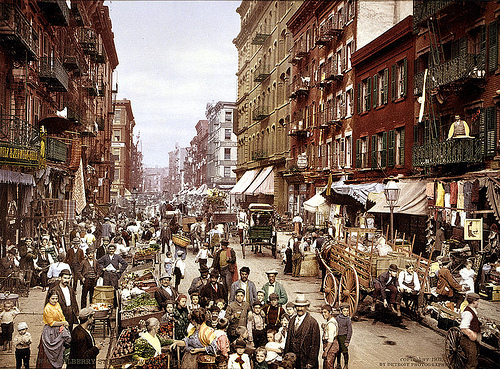
A young mother of four wild young boys passes away. The boys’ father Philip, a businessman, decides that the best place for  boys is on a farm breathing in the fresh air of the country. He buys land in the interior of Maine and sends the boys up there with a few hired hands to develop the farm. He spends most of his time focused on his work in New York while his boys run wild and free.

Eight months later the boys receive an exciting letter. Their father has re-married, they will now have a new mother to care for them. Even more exciting was the news that they would also have a new little step-sister, only 6 years old. Enter Lizzie May Ulmer.

The following is an excerpt from Adventures and Reminiscences of A Volunteer  :
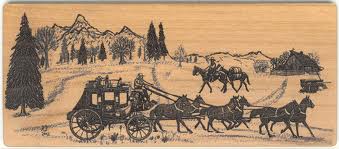
We did not know what day they would arrive. So each day about the time the stage coach from Belfast should pass the corners, we would perch ourselves on the fence in front of the house to watch for it, and when it did come in sight, wonder if the folks were in it; if they were, it would turn at the corners and come toward our house. Day after day passed, and they did not come, and we had kind of forgotten about it. Finally one day while we were all busy burning brush, brother Charlie came rushing towards us shouting, “The stage coach is coming! The stage is coming!” Well, such a scampering for the house! We didn’t have time to wash or fix up, and our appearance would certainly not inspire our city visitors with much paternal pride or affection; we looked like charcoal burners. Our faces, hands and clothes were black and begrimed from the burning brush, but we couldn’t help it; we were obliged to receive and welcome them as we were. I pulled up a handful of grass and tried to wipe my face, but the grass being wet, it left streaks all over it, and I looked more like a bogie man than anything else. We all struggled to brush up and smooth our hair, but it was no use, the stage coach was upon us, the door opened, father jumped out, and as we crowded around him, he looked at us in perfect amazement and with a kind of humiliated expression behind a pleasant fatherly smile he exclaimed, “Well, well, you are a nice dirty looking lot of boys. Lizzie,” addressing his wife and helping her to alight, “This is our family, a little smoky; I can’t tell which is which, so we’ll have to wait till they get their faces washed to introduce them by their names.” But our new mother was equal to the occasion for coming to each of us, and taking our dirty faces in her hands, kissed us, saying at the same time, “Philip, don’t you mind, they are all nice, honest, hard-working boys, and I know I shall like them, even if this country air has turned their skins black.” At this moment a tiny voice called, “Please help me out.” All the boys started with a rush, each eager to embrace the little step-sister. I was there first, and in an instant, in spite of my dirty appearance, she sprang from the coach right into my arms; my brothers struggled to take her from me, but she tightened her little arms about my neck and clung to me as if I was her only protector. I started and ran with her, my brothers in full chase, down the road, over the stone walls, across the field, around the stumps with my prize, the brothers keeping up the chase till we were all completely tired out, and father compelled us to stop and bring the child to the house. Afterward we took our turns at caressing and admiring her; finally we apologized for our behavior and dirty faces, listened to father’s and mother’s congratulations, concluded father’s choice for a wife was a good one, and that our little step-sister was just exactly as we wanted her to be, and the prospect of a bright, new and happy home seemed to be already realized.

A home is all right With father and brother, But darker than night Without sister and Mother.