What’s next for George?

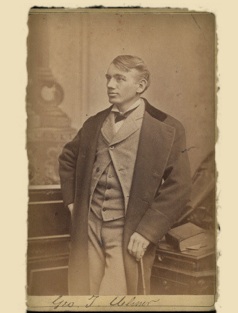
Above: a great photo of George from the George Stewart Collection

George basked in the glory of a hero’s welcome home. His family showered him with attention, patiently listening to his stories over and over again. He writes in his memoirs about his young step-sister Lizzie following him everywhere. She never tired of his enthusiastic ramblings and became a sounding board for his dreams of a big future.

For George, the War had opened his eyes to new places, new people and new experiences. He longed to get out and make a name for himself. A U.S. Tax assessment record from February of 1866 shows 16 year old George running his own “gift enterprise company” by the name of George T. Ulmer & Co. The tax assessment was $833.00. What he was doing is anyone’s guess. His charm and easy gift for gab probably made him an excellent salesman! No moss was growing on George’s stone.

In 1868 Charley married Laura and opened a small job printing plant on Washington Street in Boston. George  joined his big brother as an assistant, enjoying the sights and sounds of a bustling city. The Ulmer brothers were big dreamers and soon Charley was ready for a new venture. He  looked West for an exciting new future in an ever expanding America. After leaving Boston he published newspapers in both Denver and Pueblo, Colorado. By 1870 the driven and already successful Charley had moved his wife Laura, 2 year old son Philip and 5 month old baby boy to Chicago. It is here that I found the next official record of George.

George T Ulmer now 21 is listed on the 1870 Census as living in Chicago Ward 5 with Charley and Laura. George’s occupation is listed as “Printer” and the value of his estate is listed as $3,000.

Five years after the Civil War ended the inseparable Ulmer brothers were still together.
Next Up: Washington Street

George’s luck holds


George was young and very green. Finding his brother Charley was a joyful moment, but also an eye-opener into the realities of War. His big, strong older brother looked nothing like his memories of the smart looking soldier going off to War. This Charley was wretched in a ragged poorly patched uniform. His hat was stained, battered and full of bullet holes. His neat beard now resembled a filthy birds nest. His toes were wrapped in cloth peeking out from the front of his worn out boots. But the worst thing of all were his eyes. He had the haunted eyes that only belong to a man who has lived through war.

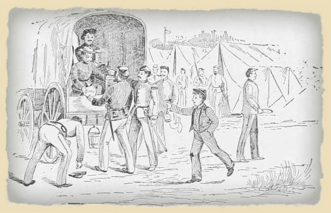
George was determined to make his brother’s life a little bit easier. He sang and told jokes and thought of ways to lighten the load of his company. He listened to his fellow soldiers as they talked about the things they missed most from home and soon an idea formulated in his head.

On one extended march, George was getting tired and upon spying  mule in a field he grabbed at his first opportunity. Riding the mule a few miles he spotted a farmhouse where he commenced his first raid returning with a box of eggs and tobacco.  He was the hero of his regiment and from that day forward he became a keen forager bringing a little joy into the lives of these war weary men.

In his words:

That successful raid gave me courage, and I began to think that was what I was destined for, and I liked it first-rate, for it was a pleasure to me to see those poor, hungry boys have any delicacy, or even enough of ordinary food.
After tramping an hour I was rewarded by seeing a calf. I drew my revolver, sneaked up and fired at poor bossy. It dropped—I was a good shot—but when I reached the poor beast I found it was as poor as a rail and covered with sores as big as my hand. I was disappointed, but cut off as much as I could that was not sore, and took it to camp. We put the kettles on the fires in short order, and my brother’s company had fresh meat broth—the first fresh meat in a month—and I tell you it was good even if it had been sore. After that episode Company H claimed me and dubbed me their mascot. I accepted the position, and from that time forth I devoted my time to foraging, stealing anything I could for my company, and I doubt if there was a company in the whole army that fared better than ours, for I was always successful in my expeditions.

George brought a little light into the dark world of war for company H. But how would he fare in one of the bloodiest and most infamous battles of the Civil War?

Next up, the Battle of Cold Harbor,VA.