I like to imagine that Lizzie May settled into a happy life in Maine surrounded by her four adoring step-brothers. Like any young farm girl of the day she probably did needlepoint and played with hoops and other such games with her brothers but may have been oblivious to the undercurrent of War that gripped the Nation.
War, however was on everyone else’s mind. The War which had begun in 1861 was becoming more and more serious. Newspapers which were hard to come by were probably eagerly sought out in the Ulmer household. By 1863, Charles the oldest brother had enlisted and was sent straight to the front. This changed the family dynamic in many ways but none were more affected than young George.
Just fourteen, George worshipped his older brother Charley and was eager to follow him to war. Against his family’s wishes young George who was small for his age, enlisted. Enlisting didn’t automatically get him mustered into service. He purchased a horse with money he had earned and rode from town to town in search of a recruiter who would send this very young, very eager boy off to war.
In George’s own words from his memoirs:
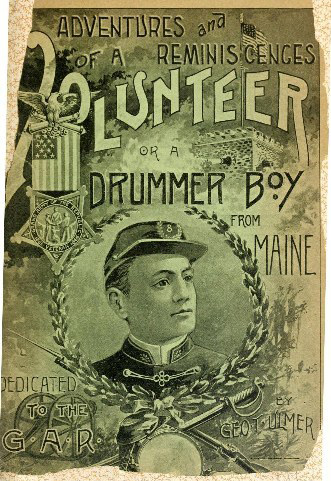 I had enlisted four times in different towns, and each time I went before a mustering officer, I was rejected. “Too small” I was every time pronounced, but I was not discouraged or dismayed–the indomitable pluck and energy of those downeast boys pervaded my system. I was bound to get there, for what I didn’t know, I did not care or didn’t stop to think. I only thought of the glory of being a soldier, little realizing what an absurd-looking one I would make; but the ambition was there, the pluck was there, and the patriotism of a man entered the breast of the wild dreamy boy. I wanted to go to the front–and I went.
After several unsuccessful attempts to be mustered into the service at Augusta, which was twenty-five miles from our little farm, I thought I would enlist from the town of Freedom and thereby get before a different mustering officer who was located in Belfast. I had grown, I thought, in the past six weeks, and before a new officer, I thought my chances of being accepted would improve; so on a bright morning in September I mounted my “gig,” … kissing my little step-sister good-bye, with a wave of my hand to father and brothers who stood in the yard and door of the dear old home, I drove away, and as I did so I could see the expressions of ridicule and doubt on their faces, while underneath it all there was a tinge of sadness and fear.
Well, I arrived in Belfast. Instead of driving direct to the stable and hotel, and putting my horse up, I drove direct to the office of the mustering officer... I entered that office like a young Napoleon. I had made up my mind to walk in before the officer very erect and dignified, even to raising myself on tiptoe. On telling the clerk my errand, he ushered me into an inner office, and imagine my surprise–my consternation–when, swinging around in his chair, I found myself in the presence of the very officer who had rejected me in Augusta so many times.
“Damn it,” said he, “will you never let up? Go home to your mother, boy, don’t pester me any more. I will not accept you, and let that end it.”
I tremblingly told him “I had grown since he saw me last, and that by the time I was mustered in I would grow some more, and that I would drum and fight, if it should prove actually necessary.”
Thus I pleaded with him for fully one hour. Finally he said, “Well, damned if I don’t muster you in, just to get rid of you. Sergeant, make out this young devil’s papers and let him go and get killed.” My heart leaped into my mouth. I tried to thank him, but he would not have it. He hurried me through, and at 5:30 P. M., September 15, 1863, I was a United States soldier. “
And so the happy Ulmer household would have more upheaval when they learned that George was to join his brother in battle.
 I get a chuckle out of the image of 14 year old George trotting along on his old mare in a state of excited bliss. His chest puffed with pride in his new uniform which was three sizes too big. Pants rolled into his boots, cloak flopping over his saddle, his too large hat obscuring his view as he rode proud as a peacock back to the farm. Just as my boys play dress-up as their favorite superhero, George seemed to be playing dress-up as a soldier.
 me and lizzie may