What would my poor mother say?

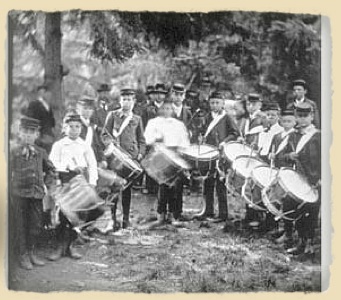
above: A candid photo from the Smithsonian archives taken in 1860 shows just how young the Drummer Boys of the Civil War were.

One morning George and his Eighth Maine regiment received orders to march to City Point to pick up recruits. George picked up his drum and marched at the front of the line. Suddenly the order to double quick march was yelled out. They were under attack and as bullets whizzed by their heads and shells exploded around them Charley screamed at George to get to the rear. Instead, in all the smoke and confusion he stayed close to his brothers in arms until fear and self-preservation took over. He found himself running  until he couldn’t run anymore. Taking inventory he was surprised to see himself completely whole but his poor drum riddled with bullet holes. George’s unbelievable run of luck had held.

As George sat there listening to the battle around him, he was joined by another young Drummer Boy from a Pennsylvania regiment. Feeling braver with two,they bragged about their exploits and adventures. George was impressed with his new friend’s amazingly profane mouth. Showing off, his new friend picked up a tent stake and tried to stake it to show what he would do to their enemies if he ever got a hold of them. Unable to get the stake to hold he picked up an unexploded shell saying:

“I’ll make a mawl of it and drive that damned rebel stake into the ground with one of their own damned shells, be damned if I don’t.” Inserting the broom handle into the end of the shell he walked over to a stump, and taking the shell in both hands commenced pounding onto the stick against the stump; “damned tight fit,” he hollored to me.

George story soon took a shocking turn as he writes in his memoirs:

The next instant I was knocked down by a terrific explosion. I came to my senses in a minute and hastened to where he had been standing. There the poor fellow lay unconscious and completely covered with blood, there was hardly a shred of clothes on him, his hair was all burned and both hands taken completely off, as if done by a surgeon’s saw.

I was excited and horror stricken for a moment. The sight was horrible, but I quickly regained my composure, knowing that something must be done, and done quickly. So taking the snares from my drum I wound them tightly around his wrists to stop the flow of blood, then I hailed an ambulance, and we took him to the held hospital about a mile to the rear.

On the way the poor fellow regained consciousness, and looking at his mutilated wrists, and then with a quick and bewildered glance at me, “God damned tough, ain’t it,” then the tears started in his eyes, and he broke down and sobbed the rest of the way, “Oh, my God! What will my poor mother say? Oh, what will she do!”

We reached the field hospital, which is only a temporary place for the wounded where the wounds are hurriedly dressed, and then they are sent to regular hospitals, located in Baltimore, Philadelphia, Norfolk, Portsmouth, etc., where they have all the comforts possible.

We laid the little fellow down in one corner of the tent to wait his turn with the surgeon, and when I left him, he cried and begged for me to stay, but I couldn’t stand his suffering longer, so I bade him good-bye with tears streaming down my own cheeks. I hurried out, and even after I reached the outside I could hear him cry, “Oh, my God! What will my poor mother say? Oh, what will she do!”

Did George write home about this sad day? Did he question his own mortality seeing the death of someone so near his own age? No letters home have been found but as an educated boy from an educated family I am sure that George spend many hours writing about his days at War. Most likely his stories home leaned towards the  humorous so as not to upset his loving family back in Maine.
Next up: Life or Limb?

George Ulmer’s first Civil War battle

George, age 14 has followed his older brother’s lead and enlisted as a Union soldier in the Civil War. After several weeks as a corporal’s orderly he begs to be sent off to fight. Little did he know what he was asking for. By the end of the war, the Eighth Maine regiment had lost a total of 381 men out of the 1586 who had enrolled. 6 officers and 128 enlisted men were killed or mortally wounded. 4 officers and 243 enlisted men died of disease. Another 355 men were wounded and 35 ended up in confederate prisons.

Blindly, George boarded an open barge heading South. The thought of finding his beloved brother Charley kept him warm on that bitterly cold ride through the Chesapeake Bay. That evening they passed Fort Monroe up the James River and after a restless night they were awoken to the sound of gunfire. They pulled alongside a gunboat whose Captain informed them to land immediately at Fort Powhatan.

They landed on the beach without any weapons as they had not yet met up with their new regiment. They were told that a regiment of 200 African American troops led by Fitzhugh Lee were trying to hold the fort. As George and his fellow recruits had no weapons they were ordered to rush yelling into the thick of the battle in the hopes of making the enemy fear that a huge battalion of recruits had arrived.

George though cut and bleeding was lucky enough to be rescued from the sand by General Smith who made him his orderly. His new position as orderly meant that he had to carry dispatches across the field of battle with bullets whizzing past his small frame.

In his memoirs he writes:

I believe I was so small that I rode between those bullets, and from that time forth I had no fear. I felt as though I were bullet-proof. I felt as if it were ordained that I should go through the war unscathed and unscarred. It did seem so, for I would go through places where it rained bullets, and come out without a scratch. This was my experience all through, and was commented on by comrades, who said I had a charmed life. 

Charmed life or not, George survived his first battle but very quickly his heroic dreams had been tarnished by the realities of war. He and his fellow battle weary survivors were sent downstream towards City Point to finally rendezvous with the Eighth Maine, Company H. At approximately 10:00 that evening they landed on a dark shore with no one to greet them or give them orders. In the distance, gunfire  lit up the night sky. Taking this to be the Front, George heedlessly ran towards the light hoping to have found Charley at last. He writes:

I asked the first man I came to where the Eighth Maine was? He looked at me in perfect astonishment. “This is the Eighth, what’s left of it.” I asked him if he knew where my brother was–Charley Ulmer? “Oh, yes,” he said, and pointing to a little group of men, who were round a wee bit of a fire; “there he is, don’t you know him?” I hesitated, for really I could hardly tell one from the other. He saw my bewilderment, and took me by the arm and led me over to the fire. They all started and stared at me, and to save my life I could not tell which was my brother; but one more ragged than the rest uttered a suppressed cry, rushed forward, and throwing his arm about my neck, sobbed and cried like a child. “My God! my brother! Oh George, George, why did you come here?”  

And so, in the Civil War battle of brother against brother, Lizzie May’s step-brothers had found comfort in each other  so many miles from home. 

Next up, does George’s luck hold?


Saying good-bye

I get a chuckle out of the image of 14 year old George trotting along on his old mare in a state of excited bliss. His chest puffed with pride in his new uniform which was three sizes too big. Pants rolled into his boots, cloak flopping over his saddle, his too large hat obscuring his view as he rode proud as a peacock back to the farm. Just as my boys play dress-up as their favorite superhero, George seemed to be playing dress-up as a soldier.

He arrived home on one of those breathtaking days that only early fall in New England can claim. It was the 17th of September when he rounded the corner to see his family waiting for him. They had been alerted by the stage-driver that George had successfully enlisted and been mustered in.

Lizzie May and her mother had been crying but their tears turned to giggles as they caught sight of their young “soldier”. He looked more like a rag-a-muffin than a soldier, a pile of clothes atop a broken down mare.  They told themselves that no outfit would ever accept him and that George would be sent straight home. Even so, Lizzie continued her plaintive pleas to her favorite step-brother begging him not to go. It was one thing to lose Charley, but George too?

In his memoirs George wrote:

“And father said, after looking me all over:”Well, if they have mustered you in, after they see you in that uniform it will be muster out, my boy”

But George was not only mustered in, he received his orders to report to Augusta,Maine. This just proves how desperate the War had turned. Men were dying in great numbers from battle and disease. New recruits were eagerly sought and immediately sent off.

And so, on September 27th, 1863 George T Ulmer age 14 bid a tearful farewell to his family with his head filled with notions of heroism.

[As an aside, there is a wonderful Civil War Museum in Maine that documents the heroism of George and Charley’s 8th regiment . It is called the Eight Maine Regiment Memorial which is a living museum and lodge. According to their website, the Memorial building was the summer vacation home for veterans of the Civil War who fought in the 8th Maine Regiment as well as their families. William Miltmore McArthur, a Colonel of the Regiment, donated the funds to purchase the land and to build the hall]
Please visit their website for more information.