A Familiar Face

We last saw George playing hooky and puffing away on a cigar down at the steamboat landing at Fortress Monroe.  He had been spotted by a young officer arriving on a small cutter that was bringing a group of sailors from a large ocean steamer to the wharf. It was clear that the officer was not pleased to see George lazily sitting there blatantly breaking the rules.

The cutter hit the edge of the stair sending the standing officer flying backwards off the cutter. George roared with laughter clapping his hands and drawing more attention to himself. The now red-faced Officer tried to regain his balance but when he put his foot on the stair, slimey and wet from the tide, he went head over heels into the water.

When he came back to the surface covered in mud and seaweed, it was too much for George who by now was holding his sides. The other sailors had joined in on the laughter only to be screamed at by the incensed officer. He then turned his anger to George but still George could not stop himself from laughing, by now the tears streaming down his face.

In George’s memoirs he writes:

Hurriedly but cautiously climbing the slippery stairs, he made his way straight for me. I was still laughing, so hearty that my eyes were dimmed with tears! but I still puffed away at the big cigar.

He looked at me for a moment, then hitting the cigar knocked it overboard, at the same time exclaiming, “You’re too young to smoke. What you laughing at? Why don’t you salute me? Discipline! I’ll teach you discipline, confound you,” at the same time boxing my ears.

“You ‘gorramed’ little cuss, why don’t you salute me?” At the word “Gorrame” I recovered myself, looked up and recognized my brother; he had been promoted since I saw him, had raised a full beard and was in command of a regiment on his way to New Orleans and had run into Fortress Monroe for orders. I was more than pleased to see him, but wouldn’t salute him until he had soundly cuffed my ears and threatened to throw me into the water.

It was Spring of 1865 and the Ulmer brothers were re-united.
Next Up: War is Over

A Good Day Ruined

NOTE: Fort Monroe, VA was officially closed by the U.S. Army yesterday , September 15,2011 after 188 years of Army service. The Fort was handed over to the state of Virginia. The Fort, has more than 170 historic buildings, 565 acres and a significant Civil War history. There is hope that there will be a creation of a new National Park which is being evaluated by a bipartisan group in Congress and the National Park Service.

This is the 20th post in the Me and Lizzie May series. What started as just an inquisitive look into the maker of an antique steamer trunk has since morphed into a fascinating portal to the past. Lizzie, George and Charley Ulmer had all but been forgotten and yet they were stalwart, adventurous people who lived very interesting lives and in their own ways were a part of the history of this country. Cheer on George and Charley as we near the end of the War of the States and fervently hope for their survival.

After an emotional week with Confederate President Jefferson Davis, George spent his days running errands for Lieutenant Russell at and around Fortress Monroe. He was soon well known around the Fort as he was generous with his cigars bought with the additional eight dollars per month he had been detailed for the printing job. He made a mess of that job but happily still kept the salary.

One beautiful day he sat pensively smoking a new cigar without a care in the world ignoring all the commotion down at the wharf. Soon he saw for himself what all the noise was about as a huge ocean steamer came into sight and dropped anchor. The Union Captain signaled  and soon a small boat full of sailors was lowered and rowed to shore. The Officer at the stern barked one order after the other ruining George’s peaceful moment with his cigar. When they reached the wharf , the pompous Officer shielding his eyes from the strong afternoon sun pointed at George with a frown on his face.

Uh-Oh. It was strictly prohibited to smoke on the wooden wharf for obvious reasons. Up until now George had not bothered to follow any rules and had got along just fine. He puffed away in defiance pushing away the nagging feeling that the Officer looked vaguely familiar…

Next Up: A Familiar Face

Fortress Monroe

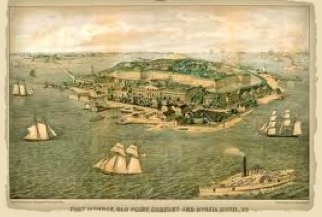
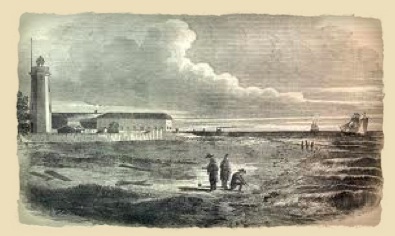
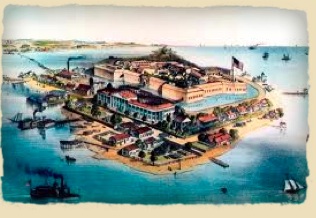
After an enjoyable few weeks assigned to light duty with the Veteran Reserves corps., George was transferred to Fortress Monroe, a military installation in Hampton,Virginia at the southern tip of the Virginia Peninsula. Fort Monroe guarded the channel between the Chesapeake Bay and Hampton Roads. This impenetrable six-sided stone fort was completely surrounded by a moat. 

It must have daunting for George to have been assigned to this imposing stone fortress. After reporting in to headquarters he wandered the grounds for a bit to get his bearings. He soon found a worn stone wall and sat down to enjoy a cigar (his new vice). This was the busiest base he had been at and there was a lot to see. Soon enough he was discovered sitting there and told to move on and get his orders. He found his superior, Lieutenant Russell who he fondly recalls in his memoirs. Lieutenant Russell needed a foreman in the Government Printing Office. For “occupation” George had filled in “Printer” on his paperwork. Printing however was his father’s profession but George figured he knew all about it so he told the Lieutenant that he “had some knowledge of it”.

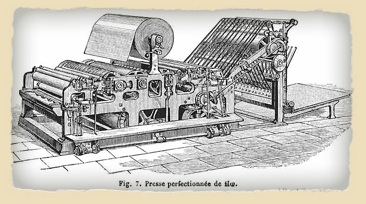
As a Printer, George was given an additional eight dollars per month, a fortune to him! His first assignment was to print 50,000 official envelopes. It was during the Civil War that many advances in printing were invented. Rotary presses were introduced, and in 1863, the Philadelphia Inquirer became the first newspaper to use a web-perfecting press that allowed a man to feed one sheet of paper through the machine and have it print on both sides. These time-saving inventions were a wonder in their day but still a far cry from our current method of keying “print” on the computer!

This picture was taken from Dictionnaire encyclopédique Trousset, also known as the Trousset encyclopedia, Paris, 1886 – 1891.

George spent the next few days printing up 50,000 official envelopes. Job completed, he patted himself on the back and decided to reward his fine work with a cigar and enjoy his day. A breathless Private found him and told him to report to Lieutenant Russell’s office right away. Proud as a peacock he marched into Lieutenant Russell’s office wondering what kind of award or even promotion he would get for his outstanding work. he even imagined  that he would be re-assigned maybe to Washington to take over the Government Printing Office there. At that moment he probably thought that he could single-handedly win the war!

Smiling, the Lieutenant asked him :

“Young man, you told me you were a printer?” 

“Yes, sir.” 

“Did you ‘O. K.’ this job?” passing one of the envelopes he held in his hand. 

“Yes sir,” I answered. 

“Umph! Is it correct?” 

“Yes, sir.” 

“It is, eh?” 

“Yes-s, sir.” 

“Umph! how do you spell business?” 

“B-u-i-s-n-e-ss,” said I. 

“You do, eh?” 

“Yes, sir.” 

“Well,” said he in an imperative manner, “our government sees fit to differ with you. You will go to your office and print fifty thousand more, but see that you spell business right, and bring me the proof. The lot you have printed we will send to Washington, and recommend that they be made into a paper mache statue of yourself, and label it ‘Buisness’.” 

And so began and ended George’s illustrious printing career…at least for now.

Next up: George and the President