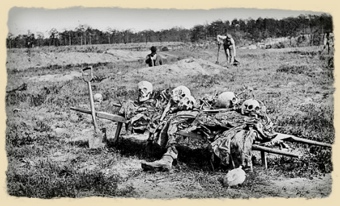
 Above: April 1865, the Government hired men to disinter the bodies left behind at Cold Harbor for identification and proper burial elsewhere.

As terrifying as a storm can be, it is in the aftermath that the true devastation is revealed. As terrifying as George found the battles of the Civil War to be, it was the horrors of their aftermath that he would take away with him forever. It is estimated that as many as 5,000-7,000 men lay seriously wounded or dead on the Cold Harbor field. The agonies of the wounded would last for days until Grant and Lee could come to an agreement on the details of a ceasefire.
When the ceasefire was finally declared, George was assigned the sad duty of stretcher corps. Wearing a white cloth on his arm in a symbol of truce, a shocked George searched for the wounded and dead of his regiment. The bloodied field was a jumbled mix of soldiers both Blue and Gray ; most dead, some crying out in their last moments, others desperate and begging for help. The twisted bodies of once beautiful horses lay mingled among the fallen soldiers. The eerie silence was periodically broken by the high pitched whinnies of the dying horses and barely lucid screams of the wounded men.
The solemnity of the day was respected on both sides. George carried water to soothe the wounded until they could be brought to a makeshift hospital that had been set up in a local tavern. He soon learned that half of his regiment had been killed in the battle. It was with tears in his eyes that he would come across friends from his regiment asleep forever on the battlefield.
In his memoirs George writes about the futility of war and his anger at the poor leadership displayed that day. He also writes about the kindnesses of his fellow soldiers, Blue or Gray. One wounded young Union soldier had laid out his rubber mat to catch the dew, he would then carefully pour the drops into the lips of a confederate soldier who was slowly bleeding to death after having had his leg blown off. In another scenario he witnessed a confederate soldier winding his suspenders around the arm of a Union soldier to stop the bleeding.
For thirteen days, the regiment stayed in the advance line. Food and supplies were running short. George decides to risk life and limb on foraging missions across enemy lines.
 me and lizzie may