On the run from Seven Pistols

Bronson Howard (aka the Dean of the American Drama) was born in Detroit, MI. As a young man he made the decision to forgo an education at Yale for the excitement of newspaper journalism in New York City.  Howard always felt that there was a great void in American theatre . He wanted to write  dramas about everyday American life at a time when British dramas were all the rage. Howard had his first success with Saratoga:Pistols For Sevenproduced in 1870 by Augustin Daly. It was wildly popular and ran for over 100 nights at the Fifth Avenue Theatre in New York, a rare achievement for an American playwright. The success of Saratoga influenced other native playwrights and started to change the face of late 19th century American theatre.

On March 23,1877 Nannary’s company (including Lizzie May and George) produced Howard’s play Saratoga at the Academy of Music in Halifax. It was a comedic society drama in five acts.

Saratoga was a fun, light romantic comedy. The lead character named Bob Sackett is engaged to the beautiful young Effie Remington, but he has also, through much bumbling and misunderstanding, promised himself to the widow Olivia Alston , the newly wed Lucy Carter AND the flirtatious Virginia Vanderpool . Attempting to escape from the mess he has gotten himself into, Bob runs off to Saratoga, where he is confronted by all four angered women. Lucy’s wildly jealous husband, Frederick and the senior Vanderpools also join the fray and add to the confusion.

The madcap feel of the play reminds me of films from the 1940’s such as The Philadelphia Story or His Girl Friday. I can completely see Cary Grant in the role of Bob Sackett, Rita Hayworth as the flirtatious Virginia and maybe Shirley Temple (in her twenties) as the young newlywed. Anyone else have any suggestions?

While I have not been able to dig up  a playbill for this performance, I would surmise that our Lizzie May played the flirtatious Virginia Vanderpool. Sweet, comedic and flirty appears to have been Lizzie May’s trademark. I can picture her now in a somewhat daring dress swaying back and forth across the stage flirting with our lead and keeping audience members in on the joke. She was gaining confidence with each role and each performance. Soon it would be her name that brought in the crowds!
May the best man win…best looking that is!

george t

                                                                                      HW HARKIN

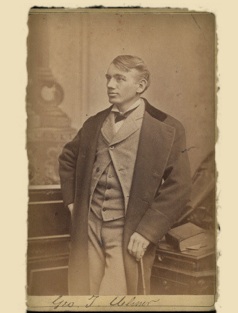
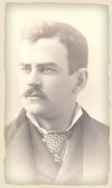
                      George Ulmer    vs.     W.S. Harkins

Today’s soap operas have nothing on 19th century melodrama.  On March 14,1877 Lizzie May’s troupe performed a play titled Ben McCulloch or Sartin as Death.  It’s a strange title and after a week of research I have found no information about the play except a review from the Acadian Recorder newspaper from March 14,1907.

Ben McCulloch (1811-1862) was an actual person who lived a very colorful life. He was a  Texas Ranger, a Sheriff, a good friend to           Davy Crockett, a Prospector during the 1849 Gold Rush and finally a Confederate General killed during a Civil War battle in 1862. The play which I believe is based on his life certainly had enough drama to draw from!

According to The Acadian Recorder dated March 14, 1907, 30 years ago the play at The Academy was Ben McCulloch or Sartin as Death. The main character was played by Oliver Dowd Byron making his first appearance in Halifax.

The reviewer writes ” Ben McCulloch is practically one of Buffalo Bill‘s blood and thunder stories dramatized, and from the beginning to end there is no cessation of interest. the lynching mob, the burning swelling, the daring rescue, the villainous plot, the robbery, the state prison, the mad Ben, the churchyard in the storm with it’s premature graves, the attempted murder, the exciting recontre, the touching meeting after long years of wasting sorrow, were the composites of the play.

George who fancied himself to be a looker must have been annoyed by the rest of the review regarding a young actor named W.S. Harkins.

W.S. Harkins is alleged to be the best looking member of the Nannary Company. it has been said that several impressionable young women in the city have fallen in love with him, and that the Academy of Music audiences have been augmented in consequence“.

Sorry George, that’s got to hurt the ego! Lizzie May does not receive a specific mention but as this is a root ’em toot ’em masculine play her role was most likely a small one as damsel in distress or saloon girl.

You decide. Check out the photos of George and W.S. . Who do you think would make the girls swoon?

The Stage

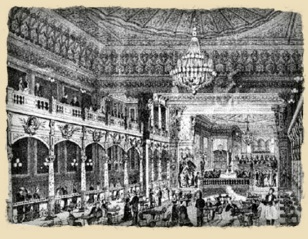
Koster & Bial’s Music Hall on 23rd street in Manhattan, the premier variety house of the late 19th century.

The second half of the 19th Century was an exciting time for the theatre. After the Civil War there was a huge influx of immigration and an enormous growth was seen in America’s cities, in particular cities on the East Coast such as Boston and New York. With the onstart of the Industrial Revolution, the growth of factories and increased productions, the continued hysteria around the Gold Rush, everything pointed to prosperity and growth for a class of people that became known as the Middle Class. Americans now had a better standard of living than ever before and with that, discretionary income to spend on entertainment.

Thanks to the expansion of the transportation system in the U.S., in particular the railroads which linked East Coast to West , actors were able to travel across America finally reaching towns that had never experienced any form of theatre before. Thousands of theaters popped up across the U.S. between 1850-1900. The growth of theatre brought an entire new cache of jobs from costumers to dramatic agencies to boarding houses and hotels who catered specifically to the trade.

Once no more than bare bones music halls soon morphed into beautiful, intricately designed theaters. The lavish productions against the backdrop of these elegant theaters became the ultimate from of entertainment.

Theater design and technology changed as well around the mid-19th century. Candlelit stages were replaced with gaslight and limelight. Limelight consisted of a block of lime heated to incandescence by means of an oxyhydrogen flame torch. The light could then be focused with mirrors and produced a quite powerful light. Theater interiors began improving in the 1850s, with ornate decoration and stall seating replacing the pit. In 1869, Laura Keen opened the remodeled Chestnut Street Theater in Philadelphia, and newspaper accounts describe the comfortable seats, convenient boxes, lovely decorations and hangings, excellent visibility, good ventilation, and baskets of flowers and hanging plants.

Theater crowds in the first half of the 19th century had gained a reputation as unruly, loud and uncouth. The improvements made to theaters in the last half of the 19th century encouraged middle and upper class patrons to attend plays, and crowds became quieter, more genteel, and less prone to cause disruptions of the performance.

The lure of the theatre was too much for George. He spent all of his free time visiting the multitude of music halls and theaters throughout Boston. At the Selwyn Theatre on Washington Street George was able to charm his way into bit parts in small productions. It felt like home and this new home was heaven.

Next Up:  A Surprise