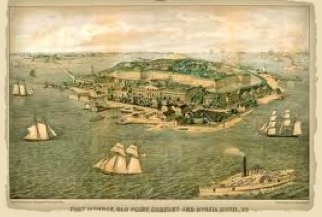
 After an enjoyable few weeks assigned to light duty with the Veteran Reserves corps., George was transferred to Fortress Monroe, a military installation in Hampton,Virginia at the southern tip of the Virginia Peninsula. Fort Monroe guarded the channel between the Chesapeake Bay and Hampton Roads. This impenetrable six-sided stone fort was completely surrounded by a moat.
It must have daunting for George to have been assigned to this imposing stone fortress. After reporting in to headquarters he wandered the grounds for a bit to get his bearings. He soon found a worn stone wall and sat down to enjoy a cigar (his new vice). This was the busiest base he had been at and there was a lot to see. Soon enough he was discovered sitting there and told to move on and get his orders. He found his superior, Lieutenant Russell who he fondly recalls in his memoirs. Lieutenant Russell needed a foreman in the Government Printing Office. For “occupation” George had filled in “Printer” on his paperwork. Printing however was his father’s profession but George figured he knew all about it so he told the Lieutenant that he “had some knowledge of it”.
As a Printer, George was given an additional eight dollars per month, a fortune to him! His first assignment was to print 50,000 official envelopes. It was during the Civil War that many advances in printing were invented. Rotary presses were introduced, and in 1863, the Philadelphia Inquirer became the first newspaper to use a web-perfecting press that allowed a man to feed one sheet of paper through the machine and have it print on both sides. These time-saving inventions were a wonder in their day but still a far cry from our current method of keying “print” on the computer!
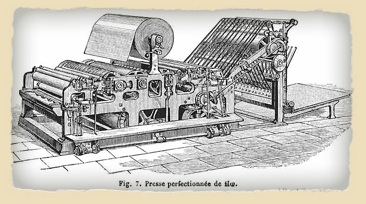 This picture was taken from Dictionnaire encyclopédique Trousset, also known as the Trousset encyclopedia, Paris, 1886 – 1891.
George spent the next few days printing up 50,000 official envelopes. Job completed, he patted himself on the back and decided to reward his fine work with a cigar and enjoy his day. A breathless Private found him and told him to report to Lieutenant Russell’s office right away. Proud as a peacock he marched into Lieutenant Russell’s office wondering what kind of award or even promotion he would get for his outstanding work. he even imagined that he would be re-assigned maybe to Washington to take over the Government Printing Office there. At that moment he probably thought that he could single-handedly win the war!
Smiling, the Lieutenant asked him :
“Young man, you told me you were a printer?”
“Yes, sir.”
“Did you ‘O. K.’ this job?” passing one of the envelopes he held in his hand.
“Yes sir,” I answered.
“Umph! Is it correct?”
“Yes, sir.”
“It is, eh?”
“Yes-s, sir.”
“Umph! how do you spell business?”
“B-u-i-s-n-e-ss,” said I.
“You do, eh?”
“Yes, sir.”
“Well,” said he in an imperative manner, “our government sees fit to differ with you. You will go to your office and print fifty thousand more, but see that you spell business right, and bring me the proof. The lot you have printed we will send to Washington, and recommend that they be made into a paper mache statue of yourself, and label it ‘Buisness’.”
And so began and ended George’s illustrious printing career…at least for now.
 me and lizzie may