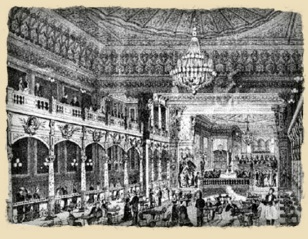
Koster & Bial’s Music Hall on 23rd street in Manhattan, the premier variety house of the late 19th century.
The second half of the 19th Century was an exciting time for the theatre. After the Civil War there was a huge influx of immigration and an enormous growth was seen in America’s cities, in particular cities on the East Coast such as Boston and New York. With the onstart of the Industrial Revolution, the growth of factories and increased productions, the continued hysteria around the Gold Rush, everything pointed to prosperity and growth for a class of people that became known as the Middle Class. Americans now had a better standard of living than ever before and with that, discretionary income to spend on entertainment.
Thanks to the expansion of the transportation system in the U.S., in particular the railroads which linked East Coast to West , actors were able to travel across America finally reaching towns that had never experienced any form of theatre before. Thousands of theaters popped up across the U.S. between 1850-1900. The growth of theatre brought an entire new cache of jobs from costumers to dramatic agencies to boarding houses and hotels who catered specifically to the trade.
Once no more than bare bones music halls soon morphed into beautiful, intricately designed theaters. The lavish productions against the backdrop of these elegant theaters became the ultimate from of entertainment.
Theater design and technology changed as well around the mid-19th century. Candlelit stages were replaced with gaslight and limelight. Limelight consisted of a block of lime heated to incandescence by means of an oxyhydrogen flame torch. The light could then be focused with mirrors and produced a quite powerful light. Theater interiors began improving in the 1850s, with ornate decoration and stall seating replacing the pit. In 1869, Laura Keen opened the remodeled Chestnut Street Theater in Philadelphia, and newspaper accounts describe the comfortable seats, convenient boxes, lovely decorations and hangings, excellent visibility, good ventilation, and baskets of flowers and hanging plants.
Theater crowds in the first half of the 19th century had gained a reputation as unruly, loud and uncouth. The improvements made to theaters in the last half of the 19th century encouraged middle and upper class patrons to attend plays, and crowds became quieter, more genteel, and less prone to cause disruptions of the performance.
The lure of the theatre was too much for George. He spent all of his free time visiting the multitude of music halls and theaters throughout Boston. At the Selwyn Theatre on Washington Street George was able to charm his way into bit parts in small productions. It felt like home and this new home was heaven.

 me and lizzie may