George the Scavenger

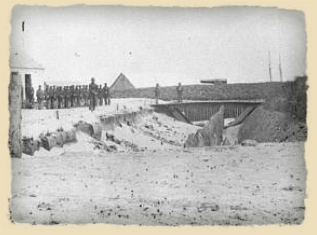
The Front at Petersburg

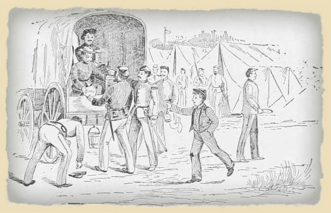
For almost 13 days, George and the remnants of the Eighth Maine regiment remained at Cold Harbor. As things settled down, they spent their days collecting their dead and nursing their injured. George with the nervous energy and cockiness of youth would take off for hours at a time foraging for his battle brothers.

He dodged Rebel sentries, sharp shooters and angry Southern farmers to beg, borrow and steal whatever he could. With supplies running low, his only thought was to bring back something special to cheer up his faithful friends. On one mission he found an orchard and filled his pockets and sack with as many apples as he could carry. George was so excited to surprise the regiment with applesauce that evening (without sugar which they did not have). His heart was in the right place, but unfortunately the apples must have been spoiled and the men were sick with the runs the next day. That almost put an end to his illicit scavenging. Almost.

Eventually the battalion was given the orders to march. One dark night in a skirmish outside of Petersburg, a shell landed in the middle of his company. Bullets were soon flying in all directions and George who had yet to shoot a gun in this War took off running. He ran, ducked and crawled until he found himself completely turned around and was not sure if he was running towards his camp or towards the enemy. Ahead was a traditional Southern mansion with a white picket fence and derelict slave cabins. He crept through the creaky gate towards a chicken house he had spotted in the yard. The fighting completely forgotten, all he could think about was bringing back some chickens to camp. What a hero he would be! Hearing the clucking of the chickens he slipped in without a thought but immediately froze as he saw two enemy soldiers sitting on a bench against the wall. Again, George’s incredible luck held. Those two soldiers were deserters who wanted to give themselves up! Proud as a peacock George marched those two back to headquarters. He was offered a two week furlough for his heroism. Later he snuck back out and took five chickens from that chicken coop which he boiled then saved until he found his brother Charley.

George may have been the luckiest boy in the Civil War. I am sure that his family enjoyed his letters home bragging about his exploits, but mostly they were probably warmed by the thought of the two brothers together. Charley looking after the precocious George as battles were waged.

Next Up: What Would My Poor Mother Say?

Picking Up The Pieces

Above: April 1865, the Government hired men to disinter the bodies left behind at Cold Harbor for identification and proper burial elsewhere.

As terrifying as a storm can be, it is in the aftermath that the true devastation is revealed. As terrifying as George found the battles of the Civil War to be, it was the horrors of their aftermath that he would take away with him forever. It is estimated that as many as 5,000-7,000 men lay seriously wounded or dead on the Cold Harbor field. The agonies of the wounded would last for days until Grant and Lee could come to an agreement on the details of a ceasefire.

When the ceasefire was finally declared, George was assigned the sad duty of stretcher corps. Wearing a white cloth on his arm in a symbol of truce, a shocked George searched for the wounded and dead of his regiment. The bloodied field was a jumbled mix of soldiers both Blue and Gray ; most dead, some crying out in their last moments, others desperate and begging for help. The twisted bodies of once beautiful horses lay mingled among the fallen soldiers. The eerie silence was periodically broken by the high pitched whinnies of the dying horses and barely lucid screams of the wounded men.

The solemnity of the day was respected on both sides. George carried water to soothe the wounded until they could be brought to a makeshift hospital that had been set up in a local tavern. He soon learned that half of his regiment had been killed in the battle. It was with tears in his eyes that he would come across friends from his regiment asleep forever on the battlefield.

In his memoirs George writes about the futility of war and his anger at the poor leadership displayed that day. He also writes about the kindnesses of his fellow soldiers, Blue or Gray. One wounded young Union soldier had laid out his rubber mat to catch the dew, he would then carefully pour the drops into the lips of a confederate soldier who was slowly bleeding to death after having had his leg blown off. In another scenario he witnessed a confederate soldier winding his suspenders around the arm of a Union soldier to stop the bleeding.

For thirteen days, the regiment stayed in the advance line. Food and supplies were running short. George decides to risk life and limb on foraging missions across enemy lines.

Next Up, George the scavenger…

To learn more, there is a fantastic article about the battle of Cold harbor written by Civil War historian Robert  N. Thompson. It was published in 2006 in Military History magazine and I highly recommend  it.

The Ulmer brothers at the Battle of Cold Harbor

The Battle of Cold Harbor

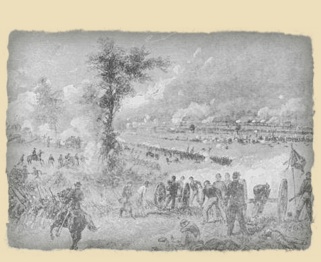
Now 15, George found himself in one of the bloodiest battles of the Civil War. From May 31st to June 12th, 1864 North and South clashed in the infamous Battle of Cold Harbor,VA. , one of the Unions greatest losses and General Grant’s biggest regrets.

Later, in his memoirs, he would sadly note, “I have always regretted that the last assault at Cold Harbor was ever made.”

I am no military history expert but I will try to summarize as best I can:

The South led by General Lee held the mouth of  Totopotomy Creek. This was an important location because it was where the Union soldiers needed to pass by to continue the march to take Richmond. After several skirmishes, the Union prevailed . Victory however was briefly lived.

The Southern troops  built fortifications that measured 7 miles long, from this vantage point, the battle turned. Grant had 108,000 men on his side including Charley and George Ulmer. Of these, 13,000 Union soldiers would be lost in the coming battle while their enemy only counted losses of 2,500. It was not a battle, it was a brutal one sided massacre.

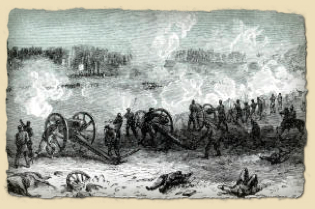
Imagine George’s terror as gunfire rained down seemingly on all sides, thunderous cannons lit up the sky Horses screamed in agony , men fell at such a fast rate that it is estimated that well over 5,000 Union soldiers lay dead after the early morning assault. The Union soldiers were basically sitting ducks as the Rebel snipers safe behind their fortified line tore them apart. Amid all this confusion and slaughter a terrified George found shelter behind a tree and covering his ears, shaking with fear he tried to block out the seemingly never ending nightmare .

And that is where Charley found him. Charley lost a toe in the battle but otherwise the brothers could not believe their luck as they looked around and realized that half of their battalion was gone.

Next up: Picking up the pieces

George’s luck holds


George was young and very green. Finding his brother Charley was a joyful moment, but also an eye-opener into the realities of War. His big, strong older brother looked nothing like his memories of the smart looking soldier going off to War. This Charley was wretched in a ragged poorly patched uniform. His hat was stained, battered and full of bullet holes. His neat beard now resembled a filthy birds nest. His toes were wrapped in cloth peeking out from the front of his worn out boots. But the worst thing of all were his eyes. He had the haunted eyes that only belong to a man who has lived through war.

George was determined to make his brother’s life a little bit easier. He sang and told jokes and thought of ways to lighten the load of his company. He listened to his fellow soldiers as they talked about the things they missed most from home and soon an idea formulated in his head.

On one extended march, George was getting tired and upon spying  mule in a field he grabbed at his first opportunity. Riding the mule a few miles he spotted a farmhouse where he commenced his first raid returning with a box of eggs and tobacco.  He was the hero of his regiment and from that day forward he became a keen forager bringing a little joy into the lives of these war weary men.

In his words:

That successful raid gave me courage, and I began to think that was what I was destined for, and I liked it first-rate, for it was a pleasure to me to see those poor, hungry boys have any delicacy, or even enough of ordinary food.
After tramping an hour I was rewarded by seeing a calf. I drew my revolver, sneaked up and fired at poor bossy. It dropped—I was a good shot—but when I reached the poor beast I found it was as poor as a rail and covered with sores as big as my hand. I was disappointed, but cut off as much as I could that was not sore, and took it to camp. We put the kettles on the fires in short order, and my brother’s company had fresh meat broth—the first fresh meat in a month—and I tell you it was good even if it had been sore. After that episode Company H claimed me and dubbed me their mascot. I accepted the position, and from that time forth I devoted my time to foraging, stealing anything I could for my company, and I doubt if there was a company in the whole army that fared better than ours, for I was always successful in my expeditions.

George brought a little light into the dark world of war for company H. But how would he fare in one of the bloodiest and most infamous battles of the Civil War?

Next up, the Battle of Cold Harbor,VA.


George Ulmer’s first Civil War battle

George, age 14 has followed his older brother’s lead and enlisted as a Union soldier in the Civil War. After several weeks as a corporal’s orderly he begs to be sent off to fight. Little did he know what he was asking for. By the end of the war, the Eighth Maine regiment had lost a total of 381 men out of the 1586 who had enrolled. 6 officers and 128 enlisted men were killed or mortally wounded. 4 officers and 243 enlisted men died of disease. Another 355 men were wounded and 35 ended up in confederate prisons.

Blindly, George boarded an open barge heading South. The thought of finding his beloved brother Charley kept him warm on that bitterly cold ride through the Chesapeake Bay. That evening they passed Fort Monroe up the James River and after a restless night they were awoken to the sound of gunfire. They pulled alongside a gunboat whose Captain informed them to land immediately at Fort Powhatan.

They landed on the beach without any weapons as they had not yet met up with their new regiment. They were told that a regiment of 200 African American troops led by Fitzhugh Lee were trying to hold the fort. As George and his fellow recruits had no weapons they were ordered to rush yelling into the thick of the battle in the hopes of making the enemy fear that a huge battalion of recruits had arrived.

George though cut and bleeding was lucky enough to be rescued from the sand by General Smith who made him his orderly. His new position as orderly meant that he had to carry dispatches across the field of battle with bullets whizzing past his small frame.

In his memoirs he writes:

I believe I was so small that I rode between those bullets, and from that time forth I had no fear. I felt as though I were bullet-proof. I felt as if it were ordained that I should go through the war unscathed and unscarred. It did seem so, for I would go through places where it rained bullets, and come out without a scratch. This was my experience all through, and was commented on by comrades, who said I had a charmed life. 

Charmed life or not, George survived his first battle but very quickly his heroic dreams had been tarnished by the realities of war. He and his fellow battle weary survivors were sent downstream towards City Point to finally rendezvous with the Eighth Maine, Company H. At approximately 10:00 that evening they landed on a dark shore with no one to greet them or give them orders. In the distance, gunfire  lit up the night sky. Taking this to be the Front, George heedlessly ran towards the light hoping to have found Charley at last. He writes:

I asked the first man I came to where the Eighth Maine was? He looked at me in perfect astonishment. “This is the Eighth, what’s left of it.” I asked him if he knew where my brother was–Charley Ulmer? “Oh, yes,” he said, and pointing to a little group of men, who were round a wee bit of a fire; “there he is, don’t you know him?” I hesitated, for really I could hardly tell one from the other. He saw my bewilderment, and took me by the arm and led me over to the fire. They all started and stared at me, and to save my life I could not tell which was my brother; but one more ragged than the rest uttered a suppressed cry, rushed forward, and throwing his arm about my neck, sobbed and cried like a child. “My God! my brother! Oh George, George, why did you come here?”  

And so, in the Civil War battle of brother against brother, Lizzie May’s step-brothers had found comfort in each other  so many miles from home. 

Next up, does George’s luck hold?


Eighth Maine Regiment off to War

Could the young drummer in front be George T Ulmer?

The Eighth Maine Regiment Band at their Headquarters in Beaufort, SC.

Eight year old Lizzie May’s days are long without her favorite step-brother to keep her company.

George however, had stars in his eyes. While in Portland waiting for his orders he decides to visit a tailor. Excited about the prospect of thrilling battles ahead, he decides to have a handsome new uniform made. After all, he couldn’t go to war looking like a beggar in his over-sized clothes!  As a 14 year old recruit completely wet behind the ears George was ignorant of uniform regulations. He just knew that it needed to be blue.

In his memoirs he writes:

He only knew the colors and knew that I wanted it nice and handsome. He made it and so covered it over with gold braid and ornaments, that you could not tell whether I was a drum-major or a brigadier-general; 

I was summoned before the colonel in command. He asked, what I was? I told him I didn’t know yet–would not know ’till I reached my regiment. He had a hearty laugh at my appearance; said I ought to be sent to some fair instead of the front. 

George’s uniform may have been a joke but his next assignment was not.

Next: George sees battle for the first time.

Saying good-bye

I get a chuckle out of the image of 14 year old George trotting along on his old mare in a state of excited bliss. His chest puffed with pride in his new uniform which was three sizes too big. Pants rolled into his boots, cloak flopping over his saddle, his too large hat obscuring his view as he rode proud as a peacock back to the farm. Just as my boys play dress-up as their favorite superhero, George seemed to be playing dress-up as a soldier.

He arrived home on one of those breathtaking days that only early fall in New England can claim. It was the 17th of September when he rounded the corner to see his family waiting for him. They had been alerted by the stage-driver that George had successfully enlisted and been mustered in.

Lizzie May and her mother had been crying but their tears turned to giggles as they caught sight of their young “soldier”. He looked more like a rag-a-muffin than a soldier, a pile of clothes atop a broken down mare.  They told themselves that no outfit would ever accept him and that George would be sent straight home. Even so, Lizzie continued her plaintive pleas to her favorite step-brother begging him not to go. It was one thing to lose Charley, but George too?

In his memoirs George wrote:

“And father said, after looking me all over:”Well, if they have mustered you in, after they see you in that uniform it will be muster out, my boy”

But George was not only mustered in, he received his orders to report to Augusta,Maine. This just proves how desperate the War had turned. Men were dying in great numbers from battle and disease. New recruits were eagerly sought and immediately sent off.

And so, on September 27th, 1863 George T Ulmer age 14 bid a tearful farewell to his family with his head filled with notions of heroism.

[As an aside, there is a wonderful Civil War Museum in Maine that documents the heroism of George and Charley’s 8th regiment . It is called the Eight Maine Regiment Memorial which is a living museum and lodge. According to their website, the Memorial building was the summer vacation home for veterans of the Civil War who fought in the 8th Maine Regiment as well as their families. William Miltmore McArthur, a Colonel of the Regiment, donated the funds to purchase the land and to build the hall]
Please visit their website for more information. 

War

I like to imagine that Lizzie May settled into a happy life in Maine surrounded by her four adoring step-brothers. Like any young farm girl of the day she probably did needlepoint and played with hoops and other such games with her brothers but may have been oblivious to the undercurrent of War that gripped the Nation.

War,  however was on everyone else’s mind. The War which had begun in 1861 was becoming more and more serious. Newspapers which were hard to come by were probably eagerly sought out in the Ulmer household. By 1863, Charles the oldest brother had enlisted and was sent straight to the front. This changed the family dynamic in many ways but none were more affected than young George.

Just fourteen, George worshipped his older brother Charley and was eager to follow him to war. Against his family’s wishes young George who was small for his age, enlisted. Enlisting didn’t automatically get him mustered into service. He purchased a horse with money he had earned and rode from town to town in search of  a recruiter who would send this very young, very eager boy off to war.

In George’s own words from his memoirs:

I had enlisted four times in different towns, and each time I went before a mustering officer, I was rejected. “Too small” I was every time pronounced, but I was not discouraged or dismayed–the indomitable pluck and energy of those downeast boys pervaded my system. I was bound to get there, for what I didn’t know, I did not care or didn’t stop to think. I only thought of the glory of being a soldier, little realizing what an absurd-looking one I would make; but the ambition was there, the pluck was there, and the patriotism of a man entered the breast of the wild dreamy boy. I wanted to go to the front–and I went. 

After several unsuccessful attempts to be mustered into the service at Augusta, which was twenty-five miles from our little farm, I thought I would enlist from the town of Freedom and thereby get before a different mustering officer who was located in Belfast. I had grown, I thought, in the past six weeks, and before a new officer, I thought my chances of being accepted would improve; so on a bright morning in September I mounted my “gig,” … kissing my little step-sister good-bye, with a wave of my hand to father and brothers who stood in the yard and door of the dear old home, I drove away, and as I did so I could see the expressions of ridicule and doubt on their faces, while underneath it all there was a tinge of sadness and fear. 

Well, I arrived in Belfast. Instead of driving direct to the stable and hotel, and putting my horse up, I drove direct to the office of the mustering officer... I entered that office like a young Napoleon. I had made up my mind to walk in before the officer very erect and dignified, even to raising myself on tiptoe. On telling the clerk my errand, he ushered me into an inner office, and imagine my surprise–my consternation–when, swinging around in his chair, I found myself in the presence of the very officer who had rejected me in Augusta so many times. 

“Damn it,” said he, “will you never let up? Go home to your mother, boy, don’t pester me any more. I will not accept you, and let that end it.” 

I tremblingly told him “I had grown since he saw me last, and that by the time I was mustered in I would grow some more, and that I would drum and fight, if it should prove actually necessary.” 

Thus I pleaded with him for fully one hour. Finally he said, “Well, damned if I don’t muster you in, just to get rid of you. Sergeant, make out this young devil’s papers and let him go and get killed.” My heart leaped into my mouth. I tried to thank him, but he would not have it. He hurried me through, and at 5:30 P. M., September 15, 1863, I was a United States soldier. “

And so the happy Ulmer household would have more upheaval when they learned that George was to join his brother in battle.


Meet Lizzie May Ulmer


My numerous Google searches of Lizzie May Ulmer have taken me down the rabbit hole and around in circles. There are snippets here and there but pulling her story together is a challenge. One thing is certain, by 1876 when her portrait was painted, Lizzie was a well-known young actress.

This beautiful portrait  is by the celebrated African-American painter Nelson A. Primus (1842-1916). This oil on canvas painting is currently on display at the Connecticut Historical Society in Hartford,CT. The original research on the painting has some discrepancies. While Lizzie May was definitely from Maine, her age would have been 20-21 at the time of the painting. The label on the back of the painting listed George T. Ulmer as the addressee and there was discussion as to which relative this was. My research shows that George T. Ulmer was actually her husband at the time. According to many articles written about her and also articles and books that her husband wrote, it is very obvious that he was very much in love with her and may have commissioned the painting.

The Hartford Courant dated January 16,1877 reports that “Primus had completed a fine portrait of a little actress in Boston (Lizzie May Ulmer) and that it had received the highest praise from the critics of that city”

This painting of Lizzie May became one of Primus’ best known works. The life of Nelson A. Primus is definitely worth the read. Born in Hartford he moved to Boston and then later to San Francisco where his art became inspired by the culture of  Chinatown.

N. A. Primus Advertisement – from the East Boston Advocate 29 April 1882 :

My research of Lizzie May has taken me in no certain order throughout her life. This is not a timeline nor a biography but more an inquisitive journey into the past.

Next up, piecing together Lizzie May’s confusing childhood…