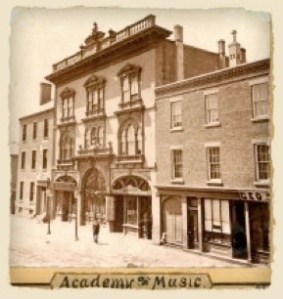
 A few posts back I wrote about the horrific fire that destroyed not only the lovely Academy of Music in St.John, New Brunswick, Canada but also 200 acres of that city. Along with many businesses, 1,612 homes were also burned to the ground.
The St. John fire occurred in June 1877, but back in January of the same year, William Nannary’s acting company with Lizzie May Ulmer as a young ingenue were blissfully unaware of the horrors that six months would bring.
According to the Acadian Recorder dated January 9,1913, in January of 1877, Nannary’ acting company played for a nine week engagement. Productions listed were: The Clouds, New Men and Old Acres, Don Caesar De Bazan, My Mother-in-Law, Home, Caste, Ingomar, Under the Gaslight, School, The King’s Rival, Inshavogue, Flying Scud, Camilla’s Husband, Pique, Shadow Brook, Streets of New York, Lady of Lyons, The Shaughbran, Rosedale, Saratoga, Colleen Bawn and many farces.
How many roles Lizzie May played within all of these performances is unknown but even if she had mere background roles in many of them, it is mind boggling to think of the sheer volume of lines and marks she had to learn. As a stock actor she would be expected to learn over 100 parts, rehearse 2-3 plays per day, and within a season possibly have 40-100 different roles. She would have been responsible for her own makeup and costumes and who knows what other tasks.
The life of a “celebrated” actor was no less rigorous. One famous actress of the day Charlotte Cushman, had over 200 roles in her repertoire making her a sought after commodity. To boost or even ensure a great box-office, many stock companies would bring in a well known star for a few performances. This “star” would bring in big crowds to the local stock theatre companies.
Even though the life of the traveling stock actor was by no means glamorous by today’s standards, compensation for this grueling life was actually fairly good by late 19th century standards. According to an essay on 19th century American theatre from the University of Washington:
Beginning actors’ salaries ranged from $3 to $6 per week; utility players’ salaries from $7 to $15 per week; “walking” ladies and gentlemen, $15 to $30; and lead actors were paid anywhere from $35 to $100 per week. Traveling stars could command $150 to $500 per 7- to 10-day engagement, plus one or more benefits. Except for the lowest ranks of actors, these salaries were good for this period, especially for women, even though they were paid less than men in comparable roles.
 me and lizzie may