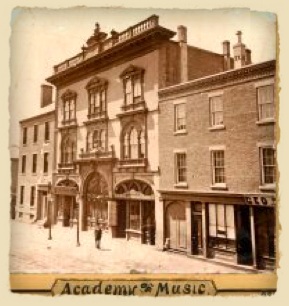
 The Academy of Music in St.John, New Brunswick, Canada was by all accounts a stunning late 19th century theater. Unlike our homogenous, spartan movie theaters of today, theaters of the 19th century were a thing of beauty.
The Academy of Music is the featured building in the photo to the left. While only three stories high, the ornate Italian style facade and the impressive 65 foot high entrance tricked the eye into thinking the building was much larger than its actual dimensions of 190 x 21 . The massive front doors were elaborately carved of solid dark walnut and weighed over 1600 pounds! The ornate interior featured broad low stairs leading to an impressive balcony while above was an even higher gallery for the VIP’s reached by a separate entrance with their own ticket office. The Academy was furnished with 600 opera chairs made of iron and the softest upholstered leather. The total seating capacity of the Academy of Music was 1200 and as patrons looked up at the ceiling they would see that all around the interior of the theatre ran an elaborately designed cornice. The interior walls were all tinted a soft pink to complement the stage lights. The large stage was 48 by 52 feet, equipped with four traps and the exquisite scenery was painted by the famed composer and musical director, Gaspard Maeder. When the building was finally completed it had cost the theater company $60,000 to build. Sadly it would only stand for 7 years before disaster struck.
The acting company built a fine reputation for their Shakespearean productions and for attracting some of the biggest names of the day to walk their stage. It was the jewel in St. John’s crown but unfortunately it was not to last. On Tuesday evening June 19th, the favorite actress Louise Pomeroy, an actress with William Nannary’s troupe, played the role of Juliet in Shakespeare’s Romeo and Juliet to a packed house.
The next evening, June 20,1877, the company was scheduled to perform Shakespeare‘s As You Like It with Louise Pomeroy to perform the lead role of Rosalind. Sadly, that day the most destructive fire to ever to hit Canada raged through the streets of St. John. In less than nine hours, two-fifths or 200 acres of the city were laid to ashes. One thousand six hundred and twelve homes were burned to the ground. The company under the leadership of William Nannary and George Waldron the stage manager all managed to escape with their lives but little else. Among the list of company names…LIZZIE MAY ULMER and GEORGE T.ULMER. This young couple escaped with their lives but all they owned…trunks, clothing, costumes etc… were all lost to the fire.
Donald Collins is a St.John freelance writer who wrote a great piece on the fire and the aftermath. Below is a small except:
The main business centre in what had been one of the most prosperous cities in North America was wiped out. More than 1,600 homes were destroyed, leaving 13,000 people homeless.
Eighteen people lost their lives – 12 from burns, four were struck by falling debris and two drowned while trying to save their property in boats.
The fire obliterated most public buildings and businesses, including the post office, city hall, customs house, five banks, 14 hotels and 14 churches, as well as theatres and schools.
The 1,500 commercial and industrial buildings that were razed included 10 retail grocers, 116 liquor dealers, 93 commission merchants, 80 law offices, 55 boarding houses, 55 shoemakers, 36 tailors, 32 flour dealers, 29 insurance agents, 29 clothing stores and 22 dry goods establishments.
Damage was estimated at $27 million in 1877 dollars, of which only $6.5 million was recovered from insurance.
In 1877 Lizzie May and George were acting with William Nannary’s company. Was this also the time that Lizzie purchased the trunk that started it all? It would make sense that after losing everything, she would have purchased a new traveling trunk. Perhaps the trunk that started this blog is the trunk that she purchased from Likly, McDonald and Rockett makers of some of the finest trunks of the day?
Next Up: Carry on?

Wikipedia describes The Actor’s Fund as a nonprofit umbrella charitable organization that assists American entertainment and performing arts professionals through a broad spectrum of programs, including comprehensive social services, health services, supportive and affordable housing, employment and training services, and skilled nursing and assisted living care.


 me and lizzie may