Lizzie May’s growing fame


Late 1876 through 1877 were tumultuous years for young Lizzie May. She had the pressures of a young wife and mother as well as the stresses of  traveling Atlantic Canada and New England with one of William Nannary’s theater companies .

Nannary dominated Atlantic Canadian theatre from 1873 to 1880. He promoted, helped sustain and, where it was lacking, attempted to provide a substantial theatrical presence, at one time paying salaries approaching $4,700 per week while employing over 100 people in various enterprises. 

While not an over night success, Lizzie’s fame was growing. She was  enough of a stand out to have had her portrait painted by the celebrated African-American painter Nelson A. Primus (1842-1916). This painting as seen above is currently on display at the Connecticut Historical Society in Hartford,CT.  The label on the back of the painting listed George T. Ulmer as the addressee. Did husband George commission the painting of his beloved Lizzie and if so how on earth could he afford such a luxury? Or had Lizzie somehow captured the attention of Primus himself? Perhaps Primus or a benefactor had spotted Lizzie in a performance? It is fun to speculate.

The Hartford Courant dated January 16,1877 reports;  

“Primus had completed a fine portrait of a little actress in Boston (Lizzie May Ulmer) and that it had received the highest praise from the critics of that city.” The painting of Lizzie May became one of Primus’ best known works.

Then by  1879 William Nannary’s successful run at the box office was slumping, tastes were changing. In July of 1880 he called it quits and emigrated with his family to America settling in San Francisco.

After an exhausting touring season and the terror of being caught up in the Great Fire of St. John, Lizzie and George needed a break. They left Canada returned to their beloved Boston.

Terror On Tour

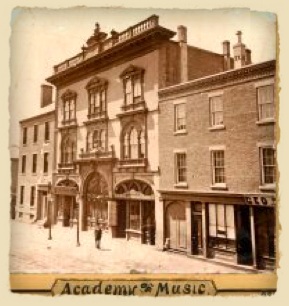
The Academy of Music in St.John, New Brunswick, Canada was by all accounts a stunning late 19th century theater. Unlike our homogenous, spartan movie theaters of today, theaters of the 19th century were a thing of beauty.

The Academy of Music is the featured building in the photo to the left. While only three stories high, the ornate Italian style facade and the impressive 65 foot high entrance tricked the eye into thinking the building was much larger than its actual dimensions of  190 x 21 . The massive front doors were elaborately carved of solid dark walnut and weighed over 1600 pounds! The ornate interior featured broad low stairs leading to an impressive balcony while above was an even higher gallery for the VIP’s reached by a separate entrance with their own ticket office. The Academy was furnished with 600 opera chairs made of iron and the softest upholstered leather. The total seating capacity of the Academy of Music was 1200 and as patrons looked up at the ceiling they would see that all around the  interior of the theatre ran an elaborately designed cornice. The interior walls were all tinted a soft pink to complement the stage lights. The large stage was 48 by 52 feet,  equipped with four traps and the exquisite scenery was painted by the famed composer and musical director, Gaspard Maeder. When the building was finally completed it had cost the theater company $60,000 to build. Sadly it would only stand for 7 years before disaster struck.

The acting company built a fine reputation for their Shakespearean productions and for attracting some of the biggest names of the day to walk their stage. It was the jewel in St. John’s crown but unfortunately it was not to last. On Tuesday evening June 19th, the favorite actress Louise Pomeroy, an actress with William Nannary’s troupe, played the role of Juliet in Shakespeare’s Romeo and Juliet to a packed house.

The next evening, June 20,1877, the company was scheduled to perform Shakespeare‘s As You Like It with Louise Pomeroy to perform the lead role of Rosalind. Sadly, that day the most destructive fire to ever to hit Canada raged through the streets of St. John. In less than nine hours, two-fifths or 200 acres of the city were laid to ashes. One thousand six hundred and twelve homes were burned to the ground. The company under the leadership of William Nannary and George Waldron the stage manager all managed to escape with their lives but little else. Among the list of company names…LIZZIE MAY ULMER and GEORGE T.ULMER. This young couple escaped with their lives but all they owned…trunks, clothing, costumes etc… were all lost to the fire.

Donald Collins is a St.John freelance writer who wrote a great piece on the fire and the aftermath. Below is a small except:

The main business centre in what had been one of the most prosperous cities in North America was wiped out. More than 1,600 homes were destroyed, leaving 13,000 people homeless. 
   Eighteen people lost their lives – 12 from burns, four were struck by falling debris and two drowned while trying to save their property in boats. 
   The fire obliterated most public buildings and businesses, including the post office, city hall, customs house, five banks, 14 hotels and 14 churches, as well as theatres and schools. 
   The 1,500 commercial and industrial buildings that were razed included 10 retail grocers, 116 liquor dealers, 93 commission merchants, 80 law offices, 55 boarding houses, 55 shoemakers, 36 tailors, 32 flour dealers, 29 insurance agents, 29 clothing stores and 22 dry goods establishments. 
   Damage was estimated at $27 million in 1877 dollars, of which only $6.5 million was recovered from insurance. 

In 1877 Lizzie May and George were acting with William Nannary’s company. Was this also the time that Lizzie purchased the trunk that started it all? It would make sense that after losing everything, she would have purchased a new traveling trunk. Perhaps the trunk that started this blog is the trunk that she purchased from Likly, McDonald and Rockett  makers of some of the finest trunks of the day?

Next Up: Carry on?

Lizzie May takes the stage in 1875

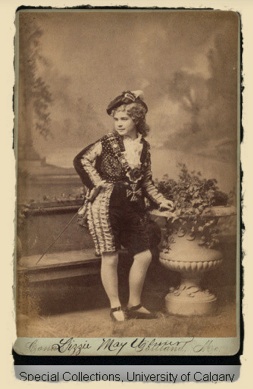
This stage photo of Lizzie May in costume is owned by the George Stewart collection at the University of Calgary,a fantastic collection of photos of the stage in the late 19th century.

The University of New Brunswick Libraries is a treasure trove of antique theater posters. I was so excited to find playbills to two plays that Lizzie May acted in at the start of her career. In fact, these are the only mentions that I can find for the 1875 season as unfortunately so much from that time period has been lost. Tracing the steps of this young actress’ career in the late 19th century shows that Lizzie May led an extraordinary life

Lizzie May acted steadily throughout 1874  building a career in small roles and productions throughout the North East.  On September 11, 1875 she had a leading role in the play Divorce by Robert Reece at the Portland Museum Theatre in Portland, ME.  This was not a huge role in a huge production in a huge city but it did connect her with a well-known playwright of the day. Robert Reece (1838– 1891) was a British comedic playwright and librettist  (opera/musical theatre) popular through the 1870’s. He wrote flashy musical burlesques and the comic operas that were all the rage. Reece was also popular for his sarcastic farces and for adapting popular French operettas into English. Lizzie May was starting to act in bigger productions by well-known writers increasing her visibiliy greatly and advancing her career.

A month later on October 9,1875 Lizzie May was once again at the Portland Museum Theatre  appearing in a lesser known play by Dion Boucicault. Boucicault was a popular Irish actor and celebrated playwright. According to wikipedia:

Boucicault was an excellent actor, especially in pathetic parts. His uncanny ability to play these low-status roles earned him the nickname “Little Man Dion” in theatrical circles. His plays are for the most part adaptations, but are often very ingenious in construction. They have had great popularity.

Lizzie May was a traveling  actress, a mother to a 2 year old (baby George Jr. was born in 1873) and a wife. Somehow she managed to juggle it all. It is interesting to note that her husband/step-brother George was not listed on the playbills for these performances. Maybe he was taking care of the baby on the nights that Lizzie performed? Or perhaps her career was starting to take off but he had yet to find his niche.


Next Up: Terror On Tour

Lizzie May’s big break

Based on this playbill from 1874  Lizzie May chose the exciting life of acting over a quiet life with her family in Maine.

Lizzie May has third billing in this musical production of Pippins “a musical variation on an old theme”. This is the earliest  playbill that  I could find with Lizzie May in a credited role. I am assuming that this is one of her first big roles. The musical ran in July of 1874 when Lizzie May was a 19 year old wife, mother to a one year old and ingenue.  It couldn’t have been a more exciting time for her!

Once I researched the names on this playbill, I realized that this was definitely a big break for Lizzie May. There are some very important players in the theatre world listed on this playbill  such as  the lessee John Stetson  who was one of the most successful theatrical managers of the late 19th century. Stetson owned and /or managed some of the most important theaters in New York and Boston. Not one to rest on his laurels he later expanded his empire by becoming a financier and real estate developer.

An interesting side note:  Stetson married the love of his life an actress named Kate Stokes who had grown up in the circus as a bare-back equestrian and later became an actress after a crippling fall. John Stetson died unexpectedly when a bad cold quickly turned to pneumonia. His broken hearted wife fell ill soon after and sadly died less than three weeks later.

Listed as proprietor on the playbill is Edward Everett Rice (1847-1924) one of the pioneers of the American musical. Also listed is J. Cheever Goodwin whom Rice joined forces with in 1874 to write Evangeline, the hugely popular burlesque musical based upon a poem by Henry Wadsworth Longfellow.

I bring up these important men of the theater because they saw something in young Lizzie May  to bring her out of the background and into a credited character role. In this poster for the musical “Pippins” Lizzie May has third billing playing the role of Cupid. This is a big step up from the chorus. Unfortunately George did not seem to have a role in this production unless it was as an uncredited background player or perhaps he was in a different production at the time. Was George’s career already waning while Lizzie May’s was on the rise?

Next Up: New roles for Lizzie May

Choosing An Actor’s Life

For young newlyweds George and Lizzie May to choose acting as their professions in the late 19th century was a true leap of faith. There were probably many arguments on the subject in the Ulmer household but as we saw during the war, George had a mind of his own and the drive and determination to do as he saw fit. The life of an actor was always in flux and required incredible physical and emotional strength. There was certainly no stability in the life they chose but being together must have been all the support they needed.

The varied performance schedule must have been exhausting. Most actors rehearsed 2-3 plays per day on top of their actual performances. A season could consist of anywhere from 40 to over 100 different plays. Stock actors such as Lizzie May and George would be expected to learn over 100 parts, many times having to memorize a new role in a matter of hours. The life of a “celebrated” actor was no less rigorous. One famous actress of the day Charlotte Cushman, had over 200 roles in her repertoire making her a sought after commodity. Big names brought in big crowds to the local stock theatre companies.

Luckily,compensation for this grueling life was actually fairly good by late 19th century standards. According to an essay on 19th century American theatre from the University of Washington:

Beginning actors’ salaries ranged from $3 to $6 per week; utility players’ salaries from $7 to $15 per week; “walking” ladies and gentlemen, $15 to $30; and lead actors were paid anywhere from $35 to $100 per week. Traveling stars could command $150 to $500 per 7- to 10-day engagement, plus one or more benefits. Except for the lowest ranks of actors, these salaries were good for this period, especially for women, even though they were paid less than men in comparable roles.

From young Civil War drummer boy to stage actor, George was following his dreams and bringing Lizzie May along for the ride.

Would Lizzie May decide to go back home to the quiet corner of Maine or follow her George through the uncertain world of the theatre?

Next Up: Role reversal

Surprise

I have mentioned before that my searches of Lizzie May Ulmer have taken me down the rabbit hole and around in circles. There are snippets here and there but pulling together the story of an actress who lived well over a hundred years ago is a challenge. One thing is certain, by 1876 when her portrait (above) was painted by the celebrated African American portraitist Nelson A. Primus, Lizzie was a 20-21 year old stage ingenue…and a wife and mother to a three year old boy named George. Named not only for her favorite step-brother but her HUSBAND as well. Yes, Lizzie May married her step-brother George. As he writes in his memoirs:

The unhappy war was over. The soldier boy returned. I arrived home at the little farm, found a royal, loving welcome from my father and brothers, and more than any other, my little step-sister, who never got tired of stories of my experience. She would sit for hours, begging me to tell her more. She was always with me wherever I would go. She was full of admiration for me. I was a hero in her eyes; I could not dispel her fancy, and I didn’t try, for she seemed the sunshine of my life. She plodded with me through all my ups and downs; through the snow and ice of winter, making summer for me the year round, and she is now my little wife. I must stop here, or I may go too far into a history of my life, which I did not intend. I know it would be uninteresting, but will simply add that myself and wife adopted the stage as a profession, and still follow it.


Next up: The life of an actor

What’s next for George?

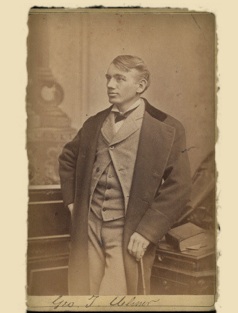
Above: a great photo of George from the George Stewart Collection

George basked in the glory of a hero’s welcome home. His family showered him with attention, patiently listening to his stories over and over again. He writes in his memoirs about his young step-sister Lizzie following him everywhere. She never tired of his enthusiastic ramblings and became a sounding board for his dreams of a big future.

For George, the War had opened his eyes to new places, new people and new experiences. He longed to get out and make a name for himself. A U.S. Tax assessment record from February of 1866 shows 16 year old George running his own “gift enterprise company” by the name of George T. Ulmer & Co. The tax assessment was $833.00. What he was doing is anyone’s guess. His charm and easy gift for gab probably made him an excellent salesman! No moss was growing on George’s stone.

In 1868 Charley married Laura and opened a small job printing plant on Washington Street in Boston. George  joined his big brother as an assistant, enjoying the sights and sounds of a bustling city. The Ulmer brothers were big dreamers and soon Charley was ready for a new venture. He  looked West for an exciting new future in an ever expanding America. After leaving Boston he published newspapers in both Denver and Pueblo, Colorado. By 1870 the driven and already successful Charley had moved his wife Laura, 2 year old son Philip and 5 month old baby boy to Chicago. It is here that I found the next official record of George.

George T Ulmer now 21 is listed on the 1870 Census as living in Chicago Ward 5 with Charley and Laura. George’s occupation is listed as “Printer” and the value of his estate is listed as $3,000.

Five years after the Civil War ended the inseparable Ulmer brothers were still together.

Next Up: Washington Street

George Ulmer’s first Civil War battle

George, age 14 has followed his older brother’s lead and enlisted as a Union soldier in the Civil War. After several weeks as a corporal’s orderly he begs to be sent off to fight. Little did he know what he was asking for. By the end of the war, the Eighth Maine regiment had lost a total of 381 men out of the 1586 who had enrolled. 6 officers and 128 enlisted men were killed or mortally wounded. 4 officers and 243 enlisted men died of disease. Another 355 men were wounded and 35 ended up in confederate prisons.

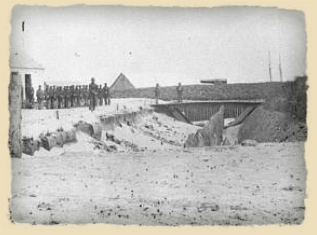
Blindly, George boarded an open barge heading South. The thought of finding his beloved brother Charley kept him warm on that bitterly cold ride through the Chesapeake Bay. That evening they passed Fort Monroe up the James River and after a restless night they were awoken to the sound of gunfire. They pulled alongside a gunboat whose Captain informed them to land immediately at Fort Powhatan.

They landed on the beach without any weapons as they had not yet met up with their new regiment. They were told that a regiment of 200 African American troops led by Fitzhugh Lee were trying to hold the fort. As George and his fellow recruits had no weapons they were ordered to rush yelling into the thick of the battle in the hopes of making the enemy fear that a huge battalion of recruits had arrived.

George though cut and bleeding was lucky enough to be rescued from the sand by General Smith who made him his orderly. His new position as orderly meant that he had to carry dispatches across the field of battle with bullets whizzing past his small frame.

In his memoirs he writes:

I believe I was so small that I rode between those bullets, and from that time forth I had no fear. I felt as though I were bullet-proof. I felt as if it were ordained that I should go through the war unscathed and unscarred. It did seem so, for I would go through places where it rained bullets, and come out without a scratch. This was my experience all through, and was commented on by comrades, who said I had a charmed life. 

Charmed life or not, George survived his first battle but very quickly his heroic dreams had been tarnished by the realities of war. He and his fellow battle weary survivors were sent downstream towards City Point to finally rendezvous with the Eighth Maine, Company H. At approximately 10:00 that evening they landed on a dark shore with no one to greet them or give them orders. In the distance, gunfire  lit up the night sky. Taking this to be the Front, George heedlessly ran towards the light hoping to have found Charley at last. He writes:

I asked the first man I came to where the Eighth Maine was? He looked at me in perfect astonishment. “This is the Eighth, what’s left of it.” I asked him if he knew where my brother was–Charley Ulmer? “Oh, yes,” he said, and pointing to a little group of men, who were round a wee bit of a fire; “there he is, don’t you know him?” I hesitated, for really I could hardly tell one from the other. He saw my bewilderment, and took me by the arm and led me over to the fire. They all started and stared at me, and to save my life I could not tell which was my brother; but one more ragged than the rest uttered a suppressed cry, rushed forward, and throwing his arm about my neck, sobbed and cried like a child. “My God! my brother! Oh George, George, why did you come here?”  

And so, in the Civil War battle of brother against brother, Lizzie May’s step-brothers had found comfort in each other  so many miles from home. 

Next up, does George’s luck hold?


Eighth Maine Regiment off to War

Could the young drummer in front be George T Ulmer?

The Eighth Maine Regiment Band at their Headquarters in Beaufort, SC.

Eight year old Lizzie May’s days are long without her favorite step-brother to keep her company.

George however, had stars in his eyes. While in Portland waiting for his orders he decides to visit a tailor. Excited about the prospect of thrilling battles ahead, he decides to have a handsome new uniform made. After all, he couldn’t go to war looking like a beggar in his over-sized clothes!  As a 14 year old recruit completely wet behind the ears George was ignorant of uniform regulations. He just knew that it needed to be blue.

In his memoirs he writes:

He only knew the colors and knew that I wanted it nice and handsome. He made it and so covered it over with gold braid and ornaments, that you could not tell whether I was a drum-major or a brigadier-general; 

I was summoned before the colonel in command. He asked, what I was? I told him I didn’t know yet–would not know ’till I reached my regiment. He had a hearty laugh at my appearance; said I ought to be sent to some fair instead of the front. 

George’s uniform may have been a joke but his next assignment was not.

Next: George sees battle for the first time.

Saying good-bye

I get a chuckle out of the image of 14 year old George trotting along on his old mare in a state of excited bliss. His chest puffed with pride in his new uniform which was three sizes too big. Pants rolled into his boots, cloak flopping over his saddle, his too large hat obscuring his view as he rode proud as a peacock back to the farm. Just as my boys play dress-up as their favorite superhero, George seemed to be playing dress-up as a soldier.

He arrived home on one of those breathtaking days that only early fall in New England can claim. It was the 17th of September when he rounded the corner to see his family waiting for him. They had been alerted by the stage-driver that George had successfully enlisted and been mustered in.

Lizzie May and her mother had been crying but their tears turned to giggles as they caught sight of their young “soldier”. He looked more like a rag-a-muffin than a soldier, a pile of clothes atop a broken down mare.  They told themselves that no outfit would ever accept him and that George would be sent straight home. Even so, Lizzie continued her plaintive pleas to her favorite step-brother begging him not to go. It was one thing to lose Charley, but George too?

In his memoirs George wrote:

“And father said, after looking me all over:”Well, if they have mustered you in, after they see you in that uniform it will be muster out, my boy”

But George was not only mustered in, he received his orders to report to Augusta,Maine. This just proves how desperate the War had turned. Men were dying in great numbers from battle and disease. New recruits were eagerly sought and immediately sent off.

And so, on September 27th, 1863 George T Ulmer age 14 bid a tearful farewell to his family with his head filled with notions of heroism.

[As an aside, there is a wonderful Civil War Museum in Maine that documents the heroism of George and Charley’s 8th regiment . It is called the Eight Maine Regiment Memorial which is a living museum and lodge. According to their website, the Memorial building was the summer vacation home for veterans of the Civil War who fought in the 8th Maine Regiment as well as their families. William Miltmore McArthur, a Colonel of the Regiment, donated the funds to purchase the land and to build the hall]
Please visit their website for more information.